Search Results for: roulette strategy

The Evolution of a Classic: Mastering the Real Money Online Baccarat Game

Mastering the Real Money Online Baccarat Game

For centuries, Baccarat was shrouded in an aura of mystery and high-stakes exclusivity. It was the game of choice for Ian Fleming’s James Bond and the preferred pastime of the French nobility. Today, that shroud has been lifted, replaced by a digital accessibility that has transformed this aristocratic pursuit into a global phenomenon. As technology bridges the gap between the opulent casino floors of Monte Carlo and the comfort of a home office, understanding the nuances of the game has never been more relevant for the modern enthusiast.

The Simplicity of the Objective

The primary appeal of Baccarat lies in its deceptive simplicity. Unlike many other card games that require complex hand rankings or intricate bluffing strategies, Baccarat is a game of comparison between two hands: the “Player” and the “Banker.” The goal is straightforward—predict which hand will have a total value closest to nine. Each card from two to nine represents its face value, while tens, jacks, queens, and kings carry a value of zero. Aces are worth one point. If a hand total exceeds nine, only the second digit is considered. For instance, a hand consisting of a seven and an eight totals fifteen, but in the world of Baccarat, it is valued at five. This mathematical elegance ensures that the game moves at a brisk pace, keeping players engaged without the cognitive fatigue associated with more complex strategy games.

The Digital Renaissance

The transition from physical tables to virtual platforms has breathed new life into the format. Players are no longer restricted by dress codes or travel requirements. Instead, they can engage with a real money online baccarat game at any time, benefiting from the same fair odds and high-definition streaming technology that defines the modern iGaming era. This digital shift has also introduced a variety of formats. While “Punto Banco” remains the most popular version, online platforms often offer “Chemin de Fer” or “Baccarat Banque” variations, allowing players to explore the historical roots of the game. Furthermore, the introduction of “Speed Baccarat” and “No Commission” variants has allowed players to tailor their experience to their specific risk tolerance and time constraints.

Strategic Discipline and the House Edge

One of the reasons Baccarat remains a staple of the gaming world is its exceptionally low house edge. When betting on the Banker, the house edge is a mere 1.06%, making it one of the most player-friendly bets in any casino environment. Even the Player bet, with a house edge of 1.24%, offers significantly better odds than most slot machines or roulette wheels. However, the “Tie” bet serves as a cautionary tale. While the 8:1 or 9:1 payout is undeniably tempting, the house edge on this specific wager often exceeds 14%. Successful players generally treat the Tie bet as a novelty rather than a core component of their strategy. Discipline is the hallmark of a seasoned Baccarat player; they understand that the game is a marathon, not a sprint, and they manage their bankroll with a focus on long-term sustainability rather than short-term windfalls.

The Psychology of the “Squeeze”

In high-stakes Baccarat rooms, the “squeeze”—the slow, methodical revealing of the cards—is a ritualistic performance. It builds tension and creates a shared emotional experience among the players. Modern online platforms have successfully replicated this psychological element through sophisticated animations and live dealer interactions. Even in a digital environment, the anticipation of the third card remains palpable. This “near-miss” psychology, combined with the fast-paced nature of the rounds, creates a unique rhythm of play. By understanding the drawing rules (the “Tableau”), players can follow the action with a deeper level of appreciation, recognizing the exact moment a hand shifts from a potential loss to a “Natural 9.”

Managing the Virtual Bankroll

As with any form of real-money engagement, bankroll management is paramount. Players are encouraged to set strict loss limits and “win goals” before they even open a virtual table. Because Baccarat is a game of streaks, it is easy to get caught up in the momentum of a winning or losing run. By utilizing tools such as deposit limits and session timers, players can ensure that their gaming remains a source of entertainment rather than a financial burden.

Conclusion

Baccarat has successfully navigated the journey from 19th-century salons to 21st-century smartphones without losing its core identity. It remains a game of elegance, statistical fairness, and thrilling simplicity. Whether you are a newcomer learning the basic rules or a veteran charting the “Big Road” for patterns, the modern landscape offers a more immersive and accessible experience than ever before.

How to Read Casino Bonus Terms Fast (Without Feeling Like You Need a Law Degree)

how to read casino bonus terms

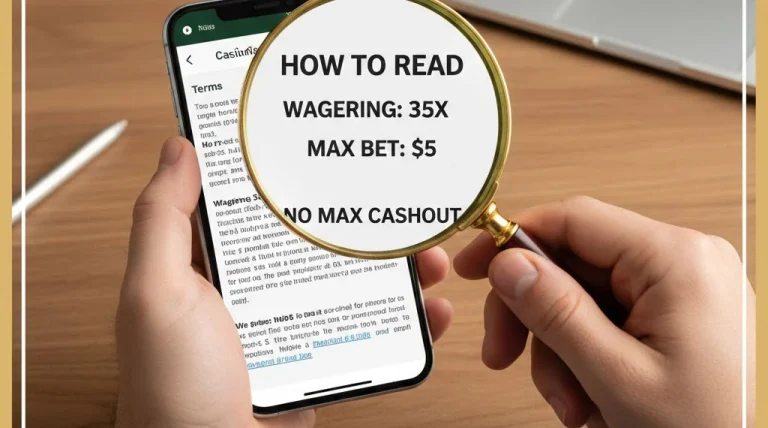
We have all been there. You see a flashy banner promising a $500 bonus, you click through, and you are immediately greeted by a wall of text that looks like a mortgage agreement. Most New Zealand players simply scroll to the bottom, click “I Accept,” and hope for the best. Unfortunately, that is exactly how players get “stung” by hidden clauses.  If you want a shortlist, start here: low-minimum deposit online casinos.

The good news? You don’t need a law degree to protect your bankroll. You just need to know which four things to look for. If you can spend two minutes scanning for these specific terms, you can avoid 99% of all casino bonus traps. Here is your “speed-reading” guide to bonus terms.

1. The “Wagering” Multiplier (The Heavy Lifter)

This is the most important number in the entire document. It tells you how much work you have to do before the money is yours.

What to look for: Look for a number followed by an “x” (e.g., 35x, 40x, 50x). The Speed Check: * 35x or lower: Excellent value.

  • 40x to 50x: Average/Standard.
  • Over 50x: Approaching the “danger zone”—it will be very difficult to walk away with cash.

The “Lawyer” Catch: Scan for the phrase “Deposit + Bonus.” If the wagering applies to both, the “real” requirement is effectively doubled. Always prefer offers where the multiplier applies to the “Bonus amount only.”

2. The “Game Weighting” Table (The Progress Killer)

Not all games are equal. If you spend an hour playing a game that doesn’t count toward your wagering, you are effectively spinning your wheels.

What to look for: Look for a percentage table or a list of “Excluded Games.” The Speed Check: * Pokies: Usually 100%.

  • Table Games (Blackjack/Roulette): Usually 5% to 10%.
  • Live Casino: Often 0%.

The Pro Tip: If you see a long list of “Excluded Pokies,” check if your favorite game is on it. Casinos often exclude high-RTP (Return to Player) slots because they make it too easy for players to beat the wagering requirements. For slot promos and comparisons, see NZ free spins promotions.

3. The “Max Bet” Rule (The Silent Account Killer)

This is the clause that gets the most players banned or their winnings voided. Almost every bonus comes with a maximum amount you can bet per spin.

What to look for: Search for the “$” symbol and the words “Max Bet” or “Maximum Stake.” The Speed Check: In the NZ market, the standard limit is usually $5.00 or $7.50.

The Trap: If you have $100 in your account and you decide to do one “big” spin of $10, you have technically breached the contract. Even if that $10 spin doesn’t win, the casino can use that breach to void all your future winnings from that bonus. Stick to $2 or $3 spins until the bonus is cleared.

4. The “Max Cashout” Cap (The Ceiling)

Imagine turning a $10 bonus into $2,000, only to be told you can only withdraw $50. This is the “Max Cashout” trap.

What to look for: Search for “Maximum Win,” “Capped Winnings,” or “Withdrawal Limit.” The Speed Check: * Deposit Matches: Should ideally have NO max cashout. If you are depositing your own money, you should be able to win an unlimited amount.

  • Free Spins/No Deposit: These almost always have a cap, often between $50 and $200.

The Strategy: If you see a very low cap (like $20), don’t waste your time. The effort required to clear the wagering isn’t worth a $20 payout.

The 2-Minute Scan Summary

Next time you open a T&C page in the Canvas of a new site, don’t read it like a book. Use Ctrl+F (or ‘Find in Page’ on your phone) and search for these four keywords:

  1. “35x” (Wagering)
  2. “Weight” (Game percentages)
  3. “Max Bet” (The $5 limit)
  4. “Cap” (Max withdrawal)

If these four numbers look fair, you are good to go. If any of them are missing or look predatory (like 70x wagering), it’s a signal to close the tab and find a more player-friendly operator.

Why It Matters

Casino terms aren’t there to provide a fun reading experience; they are there to protect the house. By learning to navigate them quickly, you move from being a “target” to being a “player.” You wouldn’t sign a car loan without checking the interest rate, so don’t accept a bonus without checking the playthrough. Speed-reading the terms isn’t just about safety—it’s about giving yourself the best possible chance to actually see a “Withdrawal Successful” message.  If you’re weighing trial offers, read no deposit bonus offers for Kiwis.

Articles

Welcome to the BigStack Blackjack Articles Hub — your go‑to resource for expert insights, practical tips, and smart strategy guides designed to help you get the most out of your online casino and blackjack experience. Here you’ll find a curated collection of articles that break down complex topics like reading bonus terms fast, mastering basic strategy, understanding game variants, bankroll management, and getting the edge at the tables — all delivered in clear, friendly language without the jargon.

Whether you’re a seasoned player looking to refine your approach or a newcomer trying to understand how online casinos work, this page is your starting point for reliable, actionable content. Each article is written with one goal in mind: to help you play smarter, enjoy more, and make informed decisions every time you sit down at the virtual felt.

Benefit from fantastic savings on Online casino bonus , just by taking a look at https://www.bonus.casino-top-uk.com

How To Win At Blackjack

When it comes to blackjack, you don?t really need to have excellent bluffing skills to win as you would in poker. Or even have an inordinate amount of luck as you would when spinning the wheel in roulette or simply trying your chances at a slot machine.

In the game of blackjack, you must not be afraid to take risks because this is the game that offers the best chances of winning. So take advantage of that and remember to always play to win in blackjack!

Blackjack Tip #1 ? Play to Win and Take Insurance Only When You Have To

Remember, in the game of blackjack, you?re only gambling against the dealer and no one else. Yes, it helps to know the cards of other players because you?ll be able to determine the probability of your cards winning but the most significant thing to concentrate on is how to beat the dealer?s cards.

Hence, don?t take insurance unless you have to since it?s truly just betting against yourself.

Blackjack Tip #2 ? The Rules of Splitting

When the first two cards you?re dealt with are a pair of the same value (like 7/7), then you have the option to split your cards into two and play them separately, just as long as you place the same amount of bet on each card.

Now, while most players would either always or never split their cards, there is actually a strategy that can be applied to this particular situation and improve your chances at winning in blackjack. If you have two 10?s or two 5?s, it?s inadvisable to split cards so simply stick with them. If you have two 8?s or 7?s for example and the dealer shows you a card that?s equal or with a lower value like 6 or 5, that?s the time you should split your cards. When it comes to having face cards, you?re advised to never split them as well. But when it comes to aces, split them immediately.

Blackjack Tip #3 ? Maximizing the Use of Double Down

If you feel that the first two cards the dealer gave you are so good, you always have the option of doubling down and doubling your bet. This is actually the best option available to blackjack players so never let the opportunity to double down slip you by. Be aggressive, especially if the situation warrants it!

Enjoyed reading the tips so far? Feeling confident right now? If so, go play blackjack and see how much your new found knowledge can help you!

by: Linda Harrison

Is Blackjack a ?Winnable? Game?

When blackjack first became a casino staple, it was assumed that it was rather like baccarat, where the house, by virtue of the rules determining play, had a statistical edge. All players and students of the game assumed that this advantage existed based on two simple facts. One, the player had to act first. Two, all busts (hands totaling over twenty-one) were losers no matter what the dealer later drew. These two rules seem to give the house an incontrovertible edge.
Conventional began to change in 1956 when a paper by Baldwin, Cantey, Maisel, and McDermont was published in the _Journal of the American Statistical Association_. This paper and a black-jack strategy manual published by Baldwin et al. the following year both attracted very little interest among non mathematicians, but it would prove to be the first step toward determining that blackjack is a “winnable” game.
Edward O. Thorp, a scientist at MIT, did understand the implications of the work of Baldwin and his colleagues and began to ex-amine two elements of the game that were previously unexamined. One, the composition of a deck of cards changes with every card dealt. Two, some deck compositions favor the player and other favor the house. In 1962, Thorp published his now famous book, _Beat the Dealer_, which contained a simple yet profound mes-sage. Unlike dice, roulette wheels, and slot machines, decks of cards have “memory.”
Blackjack, unlike Roulette for example, is a winnable game be-cause of this “memory.” Let’s look at an example. You are sit-ting at the Roulette table and the dealer throws the ball and it comes to rest on the number 9. Now, when he throws the ball again for the next round, what are the odds the ball lands on 9 again? Assuming the wheel is not rigged or the dealer is not trained to “fix” the outcome, the odds of the ball landing on 9 again are exactly the same! Let’s take it a step further. Assume that the ball does indeed land on 9 again – twice more. Now the ball has landed on the 9 three times in a row! What are the odds this happens a fourth time? Exactly the same! There is no statistical reason that the ball should “avoid” landing on 9 again.
Blackjack is different. Let’s look at a similar situation in blackjack. You are at the table with two other players. The dealer deals a 9 to each of the players at the table. Now the odds of dealing another 9 have been significantly reduced. In a six deck game the odds have been reduced from 3:49 to 7:104. This fact alone makes blackjack a winnable game.