Search Results for: systems

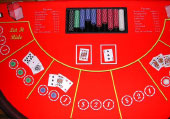
Let it Ride

Let it Ride BlackjackThe game of Blackjack has been available in online casinos since their conception. It is one of the few games where a decent knowledge of conventional blackjack strategy can reduce the house edge to a 50/50 split and one of the reasons why it is so popular. Whenever you have a game worth a flutter, perhaps at a Live Casino, someone will design a betting system for you to use, and Blackjack is no different.

One such betting system used at the Blackjack tables is called Let it Ride. Let it Ride is a positive progression betting system similar to the famous Martingale system. It’s one of the oldest forms of betting systems in operation and takes its form from the same concepts that banks use to compound interest. Let it Ride is often used in horse racing betting as well as Blackjack.

Here is the Let it Ride system in action?

You are a high roller and are playing at a $50-1000 limit table and you start by playing $1000 per hand. You are having a lucky night and start off by being dealt Blackjack immediately while playing for $1000 per hand. At odds of 3:2 you receive $1500 profit along with your original stake. You now have $2500 as a result of that bet and so you now: Let it Ride!

You could try to test your success at the system on the Live Dealer Blackjack, but you need to remember that this betting system is not for the faint-hearted and it will keep you on the edge of your seat all night long. In order to keep a modicum of control it is often prudent to select a stop-loss or profit target in advance of your session as this will make sure that you don?t get too carried away with all the excitement of Let it Ride!

A Simple Card Counting System

Let’s start with a very simple system. After you have mastered basic strategy play, this system should only take a couple of dozen hours play to learn but it will dramatically increase your results. This system will involve a simple count, a running count, bet progressions and a few minor adjustments to play.
First the count. Our count will keep track of 10’s and A’s on one hand and 2’s, 3’s, 4’s, 5’s, and 6’s on the other. Start by keeping a running count of your advantage or disadvantage. In the interest of simplicity we will start with a single deck. A deck of cards has 4 A’s and 16 10’s ( 4 each of 10, J, Q, and K) for a total of 20 cards that benefit the player. The deck also contains 20 cards that are advantageous to the dealer ( 4 each of 2, 3, 4, 5, and 6). As noted earlier, 5’s and 6’s are “better” for the dealer than 2’s, 3’s, and 4’s but this is a simple count. Much more sophisticated counts exists and the reader is encouraged to master this one first and then begin to look at more complex systems.

So, we know we start with a running count of zero. Twenty cards for the player, twenty for the dealer – no advantage – zero. As play begins, you will add 1 to your “count” for every 2, 3, 4, 5, or 6 that is dealt. For each 10 or A, subtract one. The idea is simple. If a 5 is dealt, the deck now contains 20 “10s” and 19 of the “other” cards. More tens is to your advantage so you add one. If a 10 (or J, Q, K, or A) is dealt next, the advantage is back to 0 ( 19 to 19 ). Now you have a running count. As long as play continues with the same deck you will add 1 for every 2, 3, 4, 5, or 6 you see and subtract one for every 10 or A you see.

The next step is to adjust the running count so that you have a “real” count for the entire shoe. In a one deck game (which is rare), this is simple; but in a multi-deck game the advantage will be significantly different (though still an advantage). Compare our one deck example with a six deck game. Let’s assume in our one deck game you have seen 11 “10s” and 14 of the “other” cards. This gives you a running count of +3 ( 0 plus 14 minus 11 ). In a six deck game you will have the same running count but the advantage is not as great.

Looking at the actual number of cards we will see the difference. In our one deck example, there are 9 “10s” left and only 6 of the others. If there are six decks in the shoe, and the same number of cards have been dealt, you have 109 “10s” and 106 “other” cards. It is clear that a 9:6 advantage is much different than a 109:106 advantage.

The easiest way to adjust for multiple decks is to divide your running count by the number of decks. In our example, you would have an advantage of +3 if there were only one deck, but an ad-vantage of +0.5 if there were six decks. ALL OF YOUR BET ADJUSTMENTS NEED TO BE BASED ON THE “REAL” COUNT. If you have a real count of +0.5, you have an advantage. If you have any number less than +0.5, you do not have an advantage.

Now that you have counting down, we will discuss what to do with that knowledge. Let’s take a look at a simple bet adjustment strategy that can be mastered by anyone. Start with a base unit for your betting. Your bet on each hand should be calculated based on this base unit of betting as follows. Your “default” bet is 2 times the base unit. When your “real” count drops below 0, drop your bet to the base unit. When your “real” count is greater than or equal to one, you should increase your “default” bet by the amount equal to your base unit times the count.

Let’s look at an example. If you base unit is $5, play would go as follows. When the count is positive but less than one, you will bet $10 ( 2 times $5 ). When the count is below zero, you will bet $5 ( base unit ). When the count is +1, you will bet $15 ( $10 + $5 times count). If the count is +3, you will bet $25, etc.

Counting Cards

Many inexperienced players have a misconception about card counters as mathematical geniuses who can keep track of every card in a multiple decks of cards. While there may very well be people who can do this kind of thing, card counting is not about keeping track of every card. The idea behind counting cards is to keep track of the players statistical likelihood of winning a hand and then adjusting betting and playing accordingly.
The idea behind card counting is simple gambling strategy. Any professional gambler will tell you that the way to win at gambling is to bet more when you have the advantage and bet less (or not at all) when you do not. It is that simple. In black-jack, certain cards remaining in the deck are good for the player and certain ones are not. If you “count” these cards, you will always know when you have the advantage.
Edward O. Thorp’s work confirmed that 10’s and A’s remaining in the deck were good for the player, while 5’s and 6’s remaining in the deck were bad for the player. He worked out the circumstances under which particular combinations of cards remaining in the deck gave the player and advantage over the house. He also presented the first two card-counting systems, Thorp’s five-count and Thorp’s ten-count. The latter, which is more powerful, was based on determining the ration between 10’s and non-10’s remaining in the deck. Card counting was born from irrefutable logic: Keep track of the cards: make small bets when the deck favors the house and large bets when it favors the players.
Thorp’s analysis was later improved upon by the work of many others, notably Julian Braun, Lawrence Revere, Peter Griffin, Stanford Wong, Ken Uston, Arnold Snyder, and Lance Humble. Today the game is understood at a rather deep level, and sophisticated systems exist that give the knowledgeable player a distinct edge over the house.
Which Cards Matter?
The object of card counting is to keep track of cards that are advantageous to the player. The simple question is, then, “which cards matter?”
The card most beneficial to the player is the 10. 10’s are ad-vantages to the player for several reasons. One, they will cause the dealer to bust since he is required to take cards based on the rules of play. He may not take other factors into account while playing (like you do!). Two, they turn hands that you double down on into very strong hands (which is why you double down on those hands, by the way). Three, they are used to create blackjacks. Remember that blackjacks are more beneficial to the player since getting one pays 3 to 2 but losing to one only costs the original bet! Another important card for the player is the A. Aces present soft doubling (and hitting) opportunities and they create blackjacks. Remember – blackjack is more important to the player than the house!
The worst cards for the player are the 5 and the 6 (and 2, 3, and 4 to a lesser degree). The reason these are not good for the player is simple – they are beneficial to the house. Since the house is forced by the rules of play to take cards on any hand lower than 17, the 5 and the six present the possibility of very strong hands for the dealer (remember that 10’s are not advantageous to the dealer since they make “busts” of these hands).
Before we begin to learn how to count we should talk about how this will help us. You should remember that the purpose of counting is to know when the player has an advantage and when he does not. This knowledge will do nothing for you unless you do something with it. What you want to do is adjust your betting and your play based on your advantage.
Adjusting Your Bets
Adjusting your bets is very straightforward. When the composition of the deck is in your favor, you bet more. When it is not, you bet less. Very simple. Learning just this can give you as much as a 2% advantage against the house. If that advantage does not sound like much, keep in mind that many casino slot machines only produce a 2 – 3% advantage for the casino and that is enough to make billions of dollars of profit for the casino. Granted, this is at a much higher volume than you will play at but remember that bet sizes are much smaller.
Adjusting Your Play
Learning to adjust your play based on deck composition is not an easy task, but the rewards are phenomenal. Taking this step can increase your advantage by another 2% for a total of 4% against the house. The good news is that you can learn this with a lot of practice. The principles are simple but mastering this level of play takes many hours of practice.
An expert card counter will adjust play in many different ways depending on the composition of the deck. It is common for an expert card counter to do things that “break the rules” of basic strategy like:
1. Standing earlier if the deck is very 10 rich — if the dealer can bust, so can you!
2. Standing later if the deck is very 10 poor.
3. Splitting 10’s when the deck is extremely 10 rich.
4. Doubling down on A, 9 when the deck is extremely 10 rich.
Of course, the most important play adjustment can be deciding when to start playing at a table and when to stop.

Online Gambing Addiction – Play Safely

Can you imagine being able to place a bet with just a press of a button? Can you imagine playing and betting as long as you want?

Can you imagine gambling from the comfort of your own home?

We know for a fact that gambling is risky business, and unrestrained gambling is just asking for trouble. Compulsive gamblers already have a hard time restraining themselves from the call of casinos and bookies, and now Internet gambling just takes the ante a step further.

With Internet gambling, you don?t need hard cash. Everything that is online is so easy to access. Play Baccarat, Blackjack, Craps, Keno, Roulette or Slots. Play all day, all night.

Before the 1990s, gamblers who wanted to place a casino or sports type bet in the United States basically had two choices: they could travel to a legitimate brick-and-mortar gaming establishment or place an illegal wager through a bookie. However, with the emergence of the Internet in the mid-1990s, a new form of gambling appeared; Internet gambling through gaming casinos and sports wagering. Internet gambling can take place on any electronic device that offers Internet access anywhere on the globe.

Internet gambling makes payment options for gambling individuals easy. They can just choose from several types of payment options other than credit cards. These include:

VISA and MasterCard cards: These cards are tied directly to the cardholder’s bank account. Funds for all transactions are deducted directly from the cardholder’s bank account, but cardholders can make credit card-type transactions that do not require a personal identification number.

Private-label debit cards: These cards are similar to check cards above but are issued by private companies rather than credit card associations.

On-line payment providers: These companies send and receive funds electronically for such uses as on-line auctions and purchases.

Wire transfers: Some Internet gambling sites promote this method of payment, which allows Internet gambling customers to wire money directly from a bank account to the site.

?E-cash? or digital cash: It is a digital representation of real money that can be placed on a computer hard drive, smart card and other devices with memory. It can be purchased from an authorized provider.

Internet gambling sites also offer money orders; traveler?s checks; bank drafts; cashier?s, certified, and personal checks; and a number of other electronic banking systems or processors as payment options. With Internet gambling?s easy payment options, even a non-gambler would be tempted to try.

Statistics also show that Internet gambling has nearly doubled every year since 1997 ? in 2001 it exceeded $2 billion. It also boasts 110 sport-related Internet gambling sites.

According to the American Psychological Association, Internet gambling could be just as addictive as alcohol and drugs.

This is a confession from quoted from The Gambling Problem Talking Point website:

?? I am addicted to online poker, not to mention soccer betting and casinos whenever I am in the vicinity of one.

For the longest time I thought I had the beast under control. Thought I was smarter than the pack, and shrewd enough to beat the pack. Considered my betting to be more of an investment than anything else.

How much have I lost gambling? I am afraid to tally.

Has it ruined my life? Almost ? I guess being from a wealthy family, it helped me to cover the tracks not to mention the losses.