
Search Results for: news

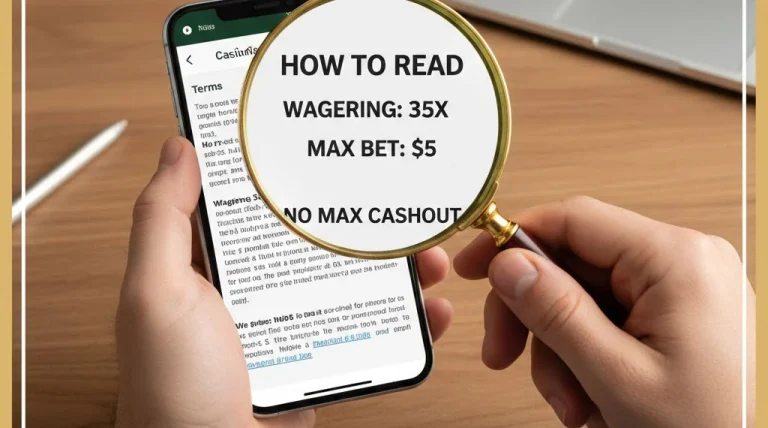
How to Read Casino Bonus Terms Fast (Without Feeling Like You Need a Law Degree)

how to read casino bonus terms

We have all been there. You see a flashy banner promising a $500 bonus, you click through, and you are immediately greeted by a wall of text that looks like a mortgage agreement. Most New Zealand players simply scroll to the bottom, click “I Accept,” and hope for the best. Unfortunately, that is exactly how players get “stung” by hidden clauses.  If you want a shortlist, start here: low-minimum deposit online casinos.

The good news? You don’t need a law degree to protect your bankroll. You just need to know which four things to look for. If you can spend two minutes scanning for these specific terms, you can avoid 99% of all casino bonus traps. Here is your “speed-reading” guide to bonus terms.

1. The “Wagering” Multiplier (The Heavy Lifter)

This is the most important number in the entire document. It tells you how much work you have to do before the money is yours.

What to look for: Look for a number followed by an “x” (e.g., 35x, 40x, 50x). The Speed Check: * 35x or lower: Excellent value.

  • 40x to 50x: Average/Standard.
  • Over 50x: Approaching the “danger zone”—it will be very difficult to walk away with cash.

The “Lawyer” Catch: Scan for the phrase “Deposit + Bonus.” If the wagering applies to both, the “real” requirement is effectively doubled. Always prefer offers where the multiplier applies to the “Bonus amount only.”

2. The “Game Weighting” Table (The Progress Killer)

Not all games are equal. If you spend an hour playing a game that doesn’t count toward your wagering, you are effectively spinning your wheels.

What to look for: Look for a percentage table or a list of “Excluded Games.” The Speed Check: * Pokies: Usually 100%.

  • Table Games (Blackjack/Roulette): Usually 5% to 10%.
  • Live Casino: Often 0%.

The Pro Tip: If you see a long list of “Excluded Pokies,” check if your favorite game is on it. Casinos often exclude high-RTP (Return to Player) slots because they make it too easy for players to beat the wagering requirements. For slot promos and comparisons, see NZ free spins promotions.

3. The “Max Bet” Rule (The Silent Account Killer)

This is the clause that gets the most players banned or their winnings voided. Almost every bonus comes with a maximum amount you can bet per spin.

What to look for: Search for the “$” symbol and the words “Max Bet” or “Maximum Stake.” The Speed Check: In the NZ market, the standard limit is usually $5.00 or $7.50.

The Trap: If you have $100 in your account and you decide to do one “big” spin of $10, you have technically breached the contract. Even if that $10 spin doesn’t win, the casino can use that breach to void all your future winnings from that bonus. Stick to $2 or $3 spins until the bonus is cleared.

4. The “Max Cashout” Cap (The Ceiling)

Imagine turning a $10 bonus into $2,000, only to be told you can only withdraw $50. This is the “Max Cashout” trap.

What to look for: Search for “Maximum Win,” “Capped Winnings,” or “Withdrawal Limit.” The Speed Check: * Deposit Matches: Should ideally have NO max cashout. If you are depositing your own money, you should be able to win an unlimited amount.

  • Free Spins/No Deposit: These almost always have a cap, often between $50 and $200.

The Strategy: If you see a very low cap (like $20), don’t waste your time. The effort required to clear the wagering isn’t worth a $20 payout.

The 2-Minute Scan Summary

Next time you open a T&C page in the Canvas of a new site, don’t read it like a book. Use Ctrl+F (or ‘Find in Page’ on your phone) and search for these four keywords:

  1. “35x” (Wagering)
  2. “Weight” (Game percentages)
  3. “Max Bet” (The $5 limit)
  4. “Cap” (Max withdrawal)

If these four numbers look fair, you are good to go. If any of them are missing or look predatory (like 70x wagering), it’s a signal to close the tab and find a more player-friendly operator.

Why It Matters

Casino terms aren’t there to provide a fun reading experience; they are there to protect the house. By learning to navigate them quickly, you move from being a “target” to being a “player.” You wouldn’t sign a car loan without checking the interest rate, so don’t accept a bonus without checking the playthrough. Speed-reading the terms isn’t just about safety—it’s about giving yourself the best possible chance to actually see a “Withdrawal Successful” message.  If you’re weighing trial offers, read no deposit bonus offers for Kiwis.

Gaming Widow Winners

Has your other half taken to poker or blackjack in a really big way? Does he move mountains to get to the nearest roulette table and constantly have a game on the go on his laptop and even his mobile phone? If this sounds familiar then welcome to the club ? you’re officially a gaming widow.

Don't be a gaming widowBut hey, this is not all bad news! You may enjoy a bit of time to yourself to play online bingo once in a while, but if his habit has escalated to a whole other level then as long as he is winning you are in for some great benefits. What starts out as an online pastime can quickly move into the real world if your man gets invited to big money games in person. Casino tournaments often take place in glamorous locations so pack your case, put on your sunglasses and get ready to check out the spa and the pool while he focuses on his game.

Another reason to tolerate his obsession is the pay off for you: how can he refuse your requests to head off out with the girls or hit the shops for some retail therapy when he is locked into his card games all the time? And who knows ? you may even get a share of his winnings to treat yourself with too: guilty husband equals open wallet syndrome is not to be ignored.

And finally, if you can’t beat ’em then join ’em! Women have a proven track record of success playing poker and blackjack so why not try your hand at the tables, virtual or in real time, and see how you get on. You are definitely not at a disadvantage and all his talk dissecting recent games may even have taught you a thing or too. Imagine his face if you turn out to be a better player than him!

Five Worst BlackJack Rules

Quick, can you tell me what are the five worst playing rules for blackjack? If you don’t know them then the next time you play blackjack you might just be bucking higher than normal odds. So let’s review these bummers to be sure you never play in a game that has them.
Blackjacks pay Even Money

This one stinks. Normally the casino pays 3 to 2 when a player gets a blackjack hand (and the dealer doesn’t also have blackjack). Getting paid 1 to 1 may not seem like a big deal but it is because the casino’s edge goes up by 2.3% (ouch).

Normally blackjack games that offer an even money payoff also have several other player favorable rules as a come on. A good example is SuperFun 21, which is offered in many casinos in Las Vegas. The game uses only a single deck of cards with liberal rules such as surrendering anytime including after hitting, doubling, or splitting. But the liberal rules do not come close to negating the 2.3% edge the house enjoys when it pays even money on blackjack hands. The bottom line is be very cautious when a casino only offers even money on a blackjack.
Blackjack pays 6 to 5

Oh come on, no casino would pay 6 to 5 for a blackjack hand you say? Well guess what? Walk up and down the strip in Las Vegas and you’ll find this game all over the place. The come on is that it’s advertised as a single deck game, which usually implies a good game for the player. But getting paid 6 to 5 on a blackjack is a much worse deal than getting paid the normal 3 to 2. How much less? For every $10 you bet and get a blackjack you’ll get paid $3 less. This increases the house edge by 1.2%.

What’s ironic is that these same casinos that offer this 6 to 5 abomination game also offer plenty of multiple deck games with a much lower house edge (partly because blackjacks are paid at the standard 3 to 2). Yet the last time I visited Las Vegas I observed all the 6 to 5 single deck tables packed with players while the multiple deck tables where much less crowded. I finally asked one player who had quit playing the 6 to 5 single deck payoff game why he choose to play it rather than the better multiple deck game. His response was that he thought 6 to 5 was a better payoff than 3 to 2. So much for the math skills of the average blackjack player (which is probably why the casinos in Las Vegas are blazingly getting away with offering this game to clueless tourists).
Doubling Down only on 11 or 10 or just 11

Often you’ll see this rule in single deck games where a player is restricted to doubling on a two card 10 and 11 (or just 11). This means you can’t double down on 9 or any soft hand (that’s not good). The house edge goes up by about 0.7% when you can only double on 11 and by 0.25% when you are restricted to just doubling on only 10 and 11.
Using 8 decks of Cards

Compared to a single deck game, the casino’s edge increases by 0.61% when 8 decks of cards are used. You would need several liberal rules to offset the 0.61% edge to make the game playable. At the minimum make sure the dealer stands on soft 17 and doubling after pair splitting is offered (ideally also late surrender).
Dealer Hits Soft 17

Many casinos (especially on the Las Vegas strip) have changed the dealer rule regarding soft 17. It used to be pretty standard that dealers must stand on all 17 hands (which includes a soft 17 hand). Nowadays, however, more casinos are changing to hit soft 17. That’s not a good change for the player because the casino edge increases by 0.20%. Given a choice you are better off playing where the rules require that dealers must stand on soft 17.

Probably the worse blackjack rule that I ever saw was dealer winning all ties. Yes, I know that’s the way you play it with your buddies when you get together for a friendly game of blackjack and poker. But in a casino, you should never play any blackjack game where the dealer wins ties. The standard casino rule is when your hand totals 21 or less and the dealer ends up with the same total, it’s a tie or push and you don’t lose or win your bet (but remember that a dealer blackjack hand beats a player’s three or more cards 21 hand). By winning tied hands the casino edge zooms by about 9%.

There are two things to keep in mind when you play blackjack. First, there has never been a game with exotic rules that has a lower house edge than the standard game. So before you decide to try a SuperFun 21 or other ‘new’; game you better check the rules.

Secondly, you should always try to pick your games carefully so that the overall mix of rules leads to a casino edge that’s as low as possible for the game you are playing (this of course assumes you know the basic playing strategy – if not, learn it!).

Dan Pronovost showed the effect of each rule on the house edge in his excellent article, Picking the Right Game, that appeared in issue #35 of the Blackjack Insider Newsletter (www.casino.com/newsletter/blackjack/archive/). This article is a good starting point to be sure you understand the impact a rule has on the house edge.

Often casinos will introduce new rules or games in their blackjack pits. An example is the new game Blackjack Switch, which recently had a trial run in Atlantic City and will soon be launched in casinos there and in Las Vegas (it’s also offered on the Internet). In this game you must play two hands and you are allowed to switch the two top cards. That very favorable player rule is offset by this new rule – when the dealer has 22, all player hands of 21 or less push (instead of win). So is the favorable switch rule offset by the very unfavorable push 22 rule? The answer is I don’t know at the moment but I’ve got several blackjack mathematicians working on this as we speak to determine the overall impact on the player (we hope to have it all unraveled in the next issue of the Blackjack Insider Newsletter).

That’s it for now. Stay positive and make sure you know the rules before you play.

By Henry Tamburin

Counting Cards

Many inexperienced players have a misconception about card counters as mathematical geniuses who can keep track of every card in a multiple decks of cards. While there may very well be people who can do this kind of thing, card counting is not about keeping track of every card. The idea behind counting cards is to keep track of the players statistical likelihood of winning a hand and then adjusting betting and playing accordingly.
The idea behind card counting is simple gambling strategy. Any professional gambler will tell you that the way to win at gambling is to bet more when you have the advantage and bet less (or not at all) when you do not. It is that simple. In black-jack, certain cards remaining in the deck are good for the player and certain ones are not. If you “count” these cards, you will always know when you have the advantage.
Edward O. Thorp’s work confirmed that 10’s and A’s remaining in the deck were good for the player, while 5’s and 6’s remaining in the deck were bad for the player. He worked out the circumstances under which particular combinations of cards remaining in the deck gave the player and advantage over the house. He also presented the first two card-counting systems, Thorp’s five-count and Thorp’s ten-count. The latter, which is more powerful, was based on determining the ration between 10’s and non-10’s remaining in the deck. Card counting was born from irrefutable logic: Keep track of the cards: make small bets when the deck favors the house and large bets when it favors the players.
Thorp’s analysis was later improved upon by the work of many others, notably Julian Braun, Lawrence Revere, Peter Griffin, Stanford Wong, Ken Uston, Arnold Snyder, and Lance Humble. Today the game is understood at a rather deep level, and sophisticated systems exist that give the knowledgeable player a distinct edge over the house.
Which Cards Matter?
The object of card counting is to keep track of cards that are advantageous to the player. The simple question is, then, “which cards matter?”
The card most beneficial to the player is the 10. 10’s are ad-vantages to the player for several reasons. One, they will cause the dealer to bust since he is required to take cards based on the rules of play. He may not take other factors into account while playing (like you do!). Two, they turn hands that you double down on into very strong hands (which is why you double down on those hands, by the way). Three, they are used to create blackjacks. Remember that blackjacks are more beneficial to the player since getting one pays 3 to 2 but losing to one only costs the original bet! Another important card for the player is the A. Aces present soft doubling (and hitting) opportunities and they create blackjacks. Remember – blackjack is more important to the player than the house!
The worst cards for the player are the 5 and the 6 (and 2, 3, and 4 to a lesser degree). The reason these are not good for the player is simple – they are beneficial to the house. Since the house is forced by the rules of play to take cards on any hand lower than 17, the 5 and the six present the possibility of very strong hands for the dealer (remember that 10’s are not advantageous to the dealer since they make “busts” of these hands).
Before we begin to learn how to count we should talk about how this will help us. You should remember that the purpose of counting is to know when the player has an advantage and when he does not. This knowledge will do nothing for you unless you do something with it. What you want to do is adjust your betting and your play based on your advantage.
Adjusting Your Bets
Adjusting your bets is very straightforward. When the composition of the deck is in your favor, you bet more. When it is not, you bet less. Very simple. Learning just this can give you as much as a 2% advantage against the house. If that advantage does not sound like much, keep in mind that many casino slot machines only produce a 2 – 3% advantage for the casino and that is enough to make billions of dollars of profit for the casino. Granted, this is at a much higher volume than you will play at but remember that bet sizes are much smaller.
Adjusting Your Play
Learning to adjust your play based on deck composition is not an easy task, but the rewards are phenomenal. Taking this step can increase your advantage by another 2% for a total of 4% against the house. The good news is that you can learn this with a lot of practice. The principles are simple but mastering this level of play takes many hours of practice.
An expert card counter will adjust play in many different ways depending on the composition of the deck. It is common for an expert card counter to do things that “break the rules” of basic strategy like:
1. Standing earlier if the deck is very 10 rich — if the dealer can bust, so can you!
2. Standing later if the deck is very 10 poor.
3. Splitting 10’s when the deck is extremely 10 rich.
4. Doubling down on A, 9 when the deck is extremely 10 rich.
Of course, the most important play adjustment can be deciding when to start playing at a table and when to stop.