Search Results for: rules of blackjack

How To Win At Blackjack

When it comes to blackjack, you don?t really need to have excellent bluffing skills to win as you would in poker. Or even have an inordinate amount of luck as you would when spinning the wheel in roulette or simply trying your chances at a slot machine.

In the game of blackjack, you must not be afraid to take risks because this is the game that offers the best chances of winning. So take advantage of that and remember to always play to win in blackjack!

Blackjack Tip #1 ? Play to Win and Take Insurance Only When You Have To

Remember, in the game of blackjack, you?re only gambling against the dealer and no one else. Yes, it helps to know the cards of other players because you?ll be able to determine the probability of your cards winning but the most significant thing to concentrate on is how to beat the dealer?s cards.

Hence, don?t take insurance unless you have to since it?s truly just betting against yourself.

Blackjack Tip #2 ? The Rules of Splitting

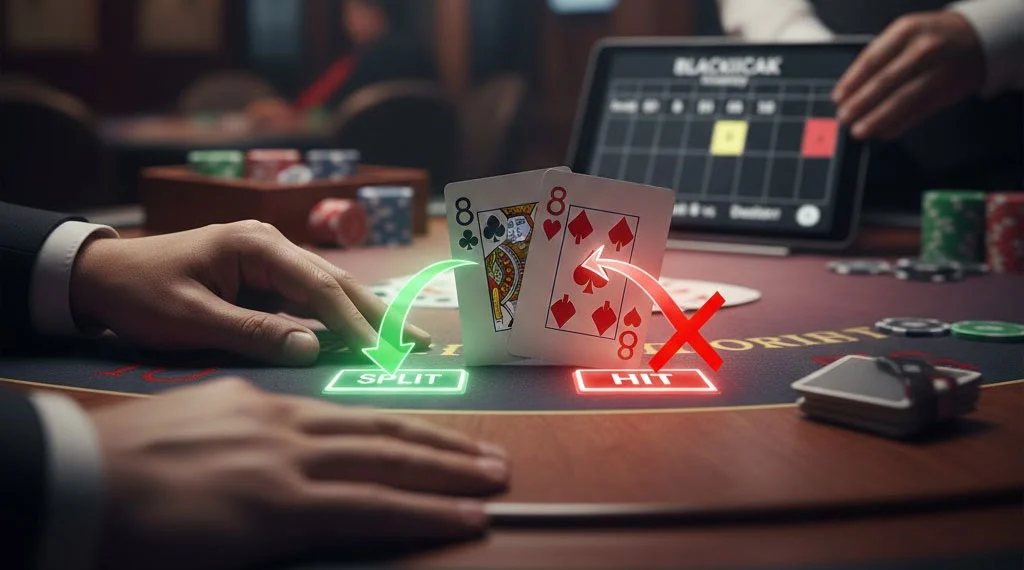
When the first two cards you?re dealt with are a pair of the same value (like 7/7), then you have the option to split your cards into two and play them separately, just as long as you place the same amount of bet on each card.

Now, while most players would either always or never split their cards, there is actually a strategy that can be applied to this particular situation and improve your chances at winning in blackjack. If you have two 10?s or two 5?s, it?s inadvisable to split cards so simply stick with them. If you have two 8?s or 7?s for example and the dealer shows you a card that?s equal or with a lower value like 6 or 5, that?s the time you should split your cards. When it comes to having face cards, you?re advised to never split them as well. But when it comes to aces, split them immediately.

Blackjack Tip #3 ? Maximizing the Use of Double Down

If you feel that the first two cards the dealer gave you are so good, you always have the option of doubling down and doubling your bet. This is actually the best option available to blackjack players so never let the opportunity to double down slip you by. Be aggressive, especially if the situation warrants it!

Enjoyed reading the tips so far? Feeling confident right now? If so, go play blackjack and see how much your new found knowledge can help you!

by: Linda Harrison

Is Blackjack a ?Winnable? Game?

When blackjack first became a casino staple, it was assumed that it was rather like baccarat, where the house, by virtue of the rules determining play, had a statistical edge. All players and students of the game assumed that this advantage existed based on two simple facts. One, the player had to act first. Two, all busts (hands totaling over twenty-one) were losers no matter what the dealer later drew. These two rules seem to give the house an incontrovertible edge.
Conventional began to change in 1956 when a paper by Baldwin, Cantey, Maisel, and McDermont was published in the _Journal of the American Statistical Association_. This paper and a black-jack strategy manual published by Baldwin et al. the following year both attracted very little interest among non mathematicians, but it would prove to be the first step toward determining that blackjack is a “winnable” game.
Edward O. Thorp, a scientist at MIT, did understand the implications of the work of Baldwin and his colleagues and began to ex-amine two elements of the game that were previously unexamined. One, the composition of a deck of cards changes with every card dealt. Two, some deck compositions favor the player and other favor the house. In 1962, Thorp published his now famous book, _Beat the Dealer_, which contained a simple yet profound mes-sage. Unlike dice, roulette wheels, and slot machines, decks of cards have “memory.”
Blackjack, unlike Roulette for example, is a winnable game be-cause of this “memory.” Let’s look at an example. You are sit-ting at the Roulette table and the dealer throws the ball and it comes to rest on the number 9. Now, when he throws the ball again for the next round, what are the odds the ball lands on 9 again? Assuming the wheel is not rigged or the dealer is not trained to “fix” the outcome, the odds of the ball landing on 9 again are exactly the same! Let’s take it a step further. Assume that the ball does indeed land on 9 again – twice more. Now the ball has landed on the 9 three times in a row! What are the odds this happens a fourth time? Exactly the same! There is no statistical reason that the ball should “avoid” landing on 9 again.
Blackjack is different. Let’s look at a similar situation in blackjack. You are at the table with two other players. The dealer deals a 9 to each of the players at the table. Now the odds of dealing another 9 have been significantly reduced. In a six deck game the odds have been reduced from 3:49 to 7:104. This fact alone makes blackjack a winnable game.

The Evolution of a Classic: Mastering the Real Money Online Baccarat Game

Mastering the Real Money Online Baccarat Game

For centuries, Baccarat was shrouded in an aura of mystery and high-stakes exclusivity. It was the game of choice for Ian Fleming’s James Bond and the preferred pastime of the French nobility. Today, that shroud has been lifted, replaced by a digital accessibility that has transformed this aristocratic pursuit into a global phenomenon. As technology bridges the gap between the opulent casino floors of Monte Carlo and the comfort of a home office, understanding the nuances of the game has never been more relevant for the modern enthusiast.

The Simplicity of the Objective

The primary appeal of Baccarat lies in its deceptive simplicity. Unlike many other card games that require complex hand rankings or intricate bluffing strategies, Baccarat is a game of comparison between two hands: the “Player” and the “Banker.” The goal is straightforward—predict which hand will have a total value closest to nine. Each card from two to nine represents its face value, while tens, jacks, queens, and kings carry a value of zero. Aces are worth one point. If a hand total exceeds nine, only the second digit is considered. For instance, a hand consisting of a seven and an eight totals fifteen, but in the world of Baccarat, it is valued at five. This mathematical elegance ensures that the game moves at a brisk pace, keeping players engaged without the cognitive fatigue associated with more complex strategy games.

The Digital Renaissance

The transition from physical tables to virtual platforms has breathed new life into the format. Players are no longer restricted by dress codes or travel requirements. Instead, they can engage with a real money online baccarat game at any time, benefiting from the same fair odds and high-definition streaming technology that defines the modern iGaming era. This digital shift has also introduced a variety of formats. While “Punto Banco” remains the most popular version, online platforms often offer “Chemin de Fer” or “Baccarat Banque” variations, allowing players to explore the historical roots of the game. Furthermore, the introduction of “Speed Baccarat” and “No Commission” variants has allowed players to tailor their experience to their specific risk tolerance and time constraints.

Strategic Discipline and the House Edge

One of the reasons Baccarat remains a staple of the gaming world is its exceptionally low house edge. When betting on the Banker, the house edge is a mere 1.06%, making it one of the most player-friendly bets in any casino environment. Even the Player bet, with a house edge of 1.24%, offers significantly better odds than most slot machines or roulette wheels. However, the “Tie” bet serves as a cautionary tale. While the 8:1 or 9:1 payout is undeniably tempting, the house edge on this specific wager often exceeds 14%. Successful players generally treat the Tie bet as a novelty rather than a core component of their strategy. Discipline is the hallmark of a seasoned Baccarat player; they understand that the game is a marathon, not a sprint, and they manage their bankroll with a focus on long-term sustainability rather than short-term windfalls.

The Psychology of the “Squeeze”

In high-stakes Baccarat rooms, the “squeeze”—the slow, methodical revealing of the cards—is a ritualistic performance. It builds tension and creates a shared emotional experience among the players. Modern online platforms have successfully replicated this psychological element through sophisticated animations and live dealer interactions. Even in a digital environment, the anticipation of the third card remains palpable. This “near-miss” psychology, combined with the fast-paced nature of the rounds, creates a unique rhythm of play. By understanding the drawing rules (the “Tableau”), players can follow the action with a deeper level of appreciation, recognizing the exact moment a hand shifts from a potential loss to a “Natural 9.”

Managing the Virtual Bankroll

As with any form of real-money engagement, bankroll management is paramount. Players are encouraged to set strict loss limits and “win goals” before they even open a virtual table. Because Baccarat is a game of streaks, it is easy to get caught up in the momentum of a winning or losing run. By utilizing tools such as deposit limits and session timers, players can ensure that their gaming remains a source of entertainment rather than a financial burden.

Conclusion

Baccarat has successfully navigated the journey from 19th-century salons to 21st-century smartphones without losing its core identity. It remains a game of elegance, statistical fairness, and thrilling simplicity. Whether you are a newcomer learning the basic rules or a veteran charting the “Big Road” for patterns, the modern landscape offers a more immersive and accessible experience than ever before.

A NZ guide to online jackpots: what they are and how they work

NZ guide to online jackpotsJackpots are the dream fuel of online casinos. They promise the kind of win that feels life-changing. But many players jump in without understanding jackpot types, eligibility rules, and why jackpot chasing can quickly become expensive if you treat it like a strategy instead of entertainment.

To compare which casinos actually offer jackpot networks and what kind of games they carry, a broad overview list can help — for example Play Online Casino NZ.

Progressive jackpots vs fixed jackpots (simple explanation)

  • Progressive jackpots: The prize pool grows as players place bets. The jackpot increases until someone wins it.
  • Fixed jackpots: The prize is set at a specific amount and doesn’t grow based on player activity.

Progressives are usually more exciting because they can become huge. Fixed jackpots are more predictable but usually smaller.

Jackpot eligibility rules: the detail that matters

Many progressive jackpots have conditions such as:

  • minimum bet requirements
  • max lines or specific bet settings
  • eligibility tied to real-money spins only
  • restricted play if you’re using a bonus

This doesn’t make jackpots “rigged.” It just means you should know what qualifies before you chase.

Why jackpots feel rare

Jackpots are designed to be statistically hard to hit. That’s what makes the prizes big. If you approach jackpots like a guaranteed path to profit, you’ll likely be disappointed. The healthier approach is:

  • play because you enjoy the base game
  • treat jackpots as a fun extra
  • avoid increasing bets to “force” a win

Choosing a jackpot-friendly casino

A jackpot-friendly platform usually has:

  • reputable providers
  • clear game info and bet requirements
  • stable performance (especially important for high spin volumes)
  • transparent banking and withdrawal policies

If you’re playing for cash and want NZ-facing options to compare, this list is useful: Online Casino Real Money NZ.

Promotions and jackpots: where people get caught

Some bonuses restrict jackpot eligibility or cap winnings, which can clash with the point of jackpot play. If you’re browsing deposit-free offers, compare them here: Top Free No Deposit Casino Bonus — but keep expectations realistic. Many no-deposit deals limit withdrawals, which can make jackpot chasing pointless.

If you’re looking at spins promos, compare them here: Free Spins No Deposit. Just remember:

  • free spins are usually tied to one specific slot
  • winnings often convert to bonus funds
  • max cash-out caps are common
  • jackpot eligibility may be excluded

Smart jackpot chasing (without wrecking your bankroll)

If you want to enjoy jackpot play responsibly:

  • set a strict budget and stick to it
  • use a steady bet size you can afford
  • choose a game you actually enjoy, jackpot or not
  • don’t chase with bigger bets after losses
  • avoid long sessions when tired or emotional

Jackpots are entertainment. The “winning strategy” is keeping it fun and affordable.

Responsible note

Jackpot chasing can be especially addictive because it’s built around hope and near-miss feelings. If gambling stops feeling fun or starts affecting your mood, finances, or relationships, support is available in NZ via the Gambling Helpline on 0800 654 655 or text 8006.

Bottom line: Jackpots can be exciting, but the best approach is informed and controlled. Understand the jackpot type, confirm eligibility rules, and keep your play within strict limits.

Maximise Potential Returns

maximize potential returns

So, you have two face cards. With a total of 20, you stand pat, right?

Maybe not. There are plenty of people who would be looking to maximise their potential return.

Splitting is something you can only do after you receive your two cards, and can only be done with identical cards. They don?t have to be completely identical, i.e. two queens of diamonds, just the same rank.

The player has to place a second bet, identical to the first, next to the original wager and the dealer splits the two cards to create a second hand.

Rules of splitting include that there are no blackjacks. If you draw a queen on top of an ace, it?s 21 and not blackjack so you could still end up not winning.

Another standard rule is that if you split aces, you only get one additional card for each split hand.
Just occasionally, you?ll be able to really make the most of your hand by re-splitting. If the cards of a post-split hand are also the same value, you can usually split them again and place a further wager on the new hand.

To take the first example, of drawing two picture cards, the best advice is to stick at 20, regardless of what the dealer holds. You have a good chance of winning with that hand, whereas you don?t know what you would get with the split hand.

There is an almost universal rule: always split aces and eights. Because of the number of picture cards in a deck, your chances of getting 21 with your split hands is pretty good.
Eights are split not because they have great potential of winning, but because 16 is a lousy total to play with.

There are tables available online that can teach you when to split, when to stick and when to hit. It?s useful to memorise these guidelines if you?re playing in a physical casino, whereas you can always have them open in another window when you?re playing online.

Written by Alex Corcoran, online bingo fan, gaming expert and online features writer, specialising in casino games such as poker, craps and Blackjack.

Disclaimer

Please read this important information before gambling at any online casino as it is your responsibility to ensure online gambling is legal in your country of residence.

  1. Gambling – This site disclaimer is for online casino and general gambling information purposes. You can not gamble on this site.
  2. Information – We will attempt to keep all our information up to date. The online casinos do, however make changes to their bonus offers and terms and conditions. No online casino will be bound by the terms of an outdated advertisement or promotion, we cannot be held liable for having any outdated information on this site. We strongly advise that you check through the casino site before playing to ascertain the casinos current terms and conditions.
  3. Legality – Gambling may be illegal in certain jurisdictions or countries. We cannot determine the legal status of online gambling for each site visitor. We would suggest that you check with your local authorities before gambling online. We also have no control as to the Registration, Country, jurisdiction, location of any person/s who partake in online/interactive gambling.
  4. South African Online Gambling – The current status is that interactive gambling from within the Republic of South Africa is illegal. Whilst we promote the Rand currency – this is for players outside of South African borders wishing to gamble in Rands. Furthermore – In terms of the Exchange Control Rules, it is illegal for South African residents to participate in foreign lotteries, sweepstakes and betting organizations.
  5. South African Rand Currency – Our advertising of the South African Rand (Zar) currency is intended for those countries trading/utilising the South African Rand (Zar) currency and for use by person/s outside of South African Borders. The Rand (Zar) currency is not for use by person/s residing in South Africa to partake in online/interactive gambling.
  6. South African Free Play Registration – You can register for free play as entertainment purposes only, you can not deposit money. Inorder to register for Free Play, you still need to download the casino software and complete the Free Play registration.Media informs you that the new proposed bill to regulate online gambling in South Africa will be submitted to the State President for signing. Once the State President has signed, online gambling will then be legal and regulated in South Africa!The only legal forms of gambling in South Africa as per the National Gambling Board notice number: 002/2007 – 16 April 2007 are the following:
    1. Betting/wagering with licensed operators.
    2. Online betting or wagering is permitted with licensed operators.
    3. Bingo conducted by licensed operators within the Republic.
    4. Casino land based gambling conducted by licensed operators within the Republic.
    5. Limited payout machines conducted by licensed operators.
  7. Age – It is illegal for persons under 18 years of age to gamble.
  8. Player Identification – This site www.bigstackblackjack.info, in accordance with all Online Casinos privacy policy/terms and conditions, does not obtain or have any access to any player/s identification or casino account details. This is private information kept by the casino only.
  9. Gambling Problem – There are a number of signs that indicate problem gambling. One of The biggest signs is when you find yourself losing more than you can afford to lose. Your online casino can help by locking your account, (you can email them to request this ) If you think you may have a problem, find the support you need at the links below:
  10. Liability – We have used whatever means we have at our disposal to try and list only those casinos who have the ability to honor their commitments. We don?t have insight into their financial status and thus will not be held liable for their actions.
  11. Arbitration – We are totally independent to any of the online casino/s, nor do we have any ownership or share holding/s with any online casino/s. Should you experience difficulty in your dealings with any of the casinos listed, we will happily provide whatever support at our disposal in an effort to resolve your dispute.
  12. Casino Rules – We remind you that online casinos have terms and conditions/rules and that it is your responsibility to familiarize yourself with the casinos rules before playing there.
  13. Welcome Bonus – Most online Casinos offer new players a welcome bonus. There is a play through requirement that the player must play before the player may cash in. The play through requirement will vary from casino to casino, we therefore advise you to read all terms and conditions including any terms and conditions relating to play through requirements.

In case you’re interested in knowing more info on online slots, stop by www.casinobonusmaster.com

Females in Poker

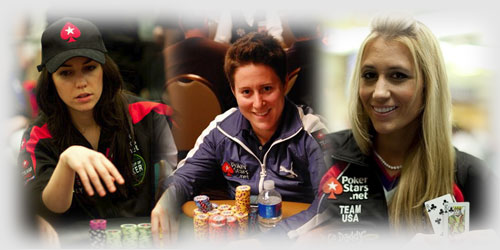
Liv Boeree, Vanessa Selbst and Vanessa Rousso

Poker is an equal opportunities game and while there may be more men at the felt than women, there?s certainly nothing stopping some women from profiting in the game. Indeed, some of the most talented players in the world are women which demonstrates that, unlike most sports, poker isn?t divided by gender.

Players such as Liv Boeree, Vanessa Selbst and Vanessa Rousso have not only proven themselves by winning million of dollars in the careers but by being students of the game; there is not one small detail they will not know about strategies and Texas holdem rules. All three are university graduates and have applied themselves to learning the art and skill of poker.

Above and beyond their capacity for playing cards, the trio have become ambassadors for the game and inspired women across the globe to learn poker.

While many women will feel intimidated at the felt by their male counterparts, the opposite is in fact true. Many male players now respect the women they face because they understand that it?s much tougher for a woman to break into the big time. Therefore, on that basis, they are much more likely to be strong player and someone to avoid playing against.

It?s true that women are a minority in the poker industry but that doesn?t mean they are the weaker sex. Indeed, some of the best players into the world are female and with more and more rising to the top it won?t be long before parity reigns in the world of bluffs, bets and bad beats.

Splitting in the game of Blackback

There are four options available to the player in a game of Blackjack once he has been dealt his starting cards. One these is to split but what exactly does this mean?

Sometimes when you are playing Blackjack you will be dealt a pocket pair such as 88, 66, 44, etc. When you are dealt a pocket pair you have the option to split. Splitting means that you divide the two cards into two separate hands. The dealer then deals you two separate cards, one to each hand, giving you the net result of two hands instead of one. When you decide to split you also have to double your wager because you are now betting on the outcome of two hands. Anyone who is unsure as to what they’re doing may be better off sticking to video poker instead.

The number of times that you are allowed to split your hand will depend on the rules of the particular casino you are playing in. Imagine you have two eights and decide to split and the dealer deals you another two eights; in some casinos you will be able to split the two eights again giving you the net result of four hands. As you can imagine the splitting of hands can win or lose you a lot more money than you initially bargained for, but it is one of the most exciting parts of the game. Remember, Blackjack has just as many nuances as slot games.

Another rule variation you need to look out for when splitting is when you are dealt a pair of aces. Some casinos will not allow you split aces, others will only allow you to draw one additional card on each ace and some will not recognize an eventual 21 as a 3:2 Blackjack hand. It’s important to bear these things in mind before you start.

Counting Cards

Many inexperienced players have a misconception about card counters as mathematical geniuses who can keep track of every card in a multiple decks of cards. While there may very well be people who can do this kind of thing, card counting is not about keeping track of every card. The idea behind counting cards is to keep track of the players statistical likelihood of winning a hand and then adjusting betting and playing accordingly.
The idea behind card counting is simple gambling strategy. Any professional gambler will tell you that the way to win at gambling is to bet more when you have the advantage and bet less (or not at all) when you do not. It is that simple. In black-jack, certain cards remaining in the deck are good for the player and certain ones are not. If you “count” these cards, you will always know when you have the advantage.
Edward O. Thorp’s work confirmed that 10’s and A’s remaining in the deck were good for the player, while 5’s and 6’s remaining in the deck were bad for the player. He worked out the circumstances under which particular combinations of cards remaining in the deck gave the player and advantage over the house. He also presented the first two card-counting systems, Thorp’s five-count and Thorp’s ten-count. The latter, which is more powerful, was based on determining the ration between 10’s and non-10’s remaining in the deck. Card counting was born from irrefutable logic: Keep track of the cards: make small bets when the deck favors the house and large bets when it favors the players.
Thorp’s analysis was later improved upon by the work of many others, notably Julian Braun, Lawrence Revere, Peter Griffin, Stanford Wong, Ken Uston, Arnold Snyder, and Lance Humble. Today the game is understood at a rather deep level, and sophisticated systems exist that give the knowledgeable player a distinct edge over the house.
Which Cards Matter?
The object of card counting is to keep track of cards that are advantageous to the player. The simple question is, then, “which cards matter?”
The card most beneficial to the player is the 10. 10’s are ad-vantages to the player for several reasons. One, they will cause the dealer to bust since he is required to take cards based on the rules of play. He may not take other factors into account while playing (like you do!). Two, they turn hands that you double down on into very strong hands (which is why you double down on those hands, by the way). Three, they are used to create blackjacks. Remember that blackjacks are more beneficial to the player since getting one pays 3 to 2 but losing to one only costs the original bet! Another important card for the player is the A. Aces present soft doubling (and hitting) opportunities and they create blackjacks. Remember – blackjack is more important to the player than the house!
The worst cards for the player are the 5 and the 6 (and 2, 3, and 4 to a lesser degree). The reason these are not good for the player is simple – they are beneficial to the house. Since the house is forced by the rules of play to take cards on any hand lower than 17, the 5 and the six present the possibility of very strong hands for the dealer (remember that 10’s are not advantageous to the dealer since they make “busts” of these hands).
Before we begin to learn how to count we should talk about how this will help us. You should remember that the purpose of counting is to know when the player has an advantage and when he does not. This knowledge will do nothing for you unless you do something with it. What you want to do is adjust your betting and your play based on your advantage.
Adjusting Your Bets
Adjusting your bets is very straightforward. When the composition of the deck is in your favor, you bet more. When it is not, you bet less. Very simple. Learning just this can give you as much as a 2% advantage against the house. If that advantage does not sound like much, keep in mind that many casino slot machines only produce a 2 – 3% advantage for the casino and that is enough to make billions of dollars of profit for the casino. Granted, this is at a much higher volume than you will play at but remember that bet sizes are much smaller.
Adjusting Your Play
Learning to adjust your play based on deck composition is not an easy task, but the rewards are phenomenal. Taking this step can increase your advantage by another 2% for a total of 4% against the house. The good news is that you can learn this with a lot of practice. The principles are simple but mastering this level of play takes many hours of practice.
An expert card counter will adjust play in many different ways depending on the composition of the deck. It is common for an expert card counter to do things that “break the rules” of basic strategy like:
1. Standing earlier if the deck is very 10 rich — if the dealer can bust, so can you!
2. Standing later if the deck is very 10 poor.
3. Splitting 10’s when the deck is extremely 10 rich.
4. Doubling down on A, 9 when the deck is extremely 10 rich.
Of course, the most important play adjustment can be deciding when to start playing at a table and when to stop.