Search Results for: wind

The Evolution of a Classic: Mastering the Real Money Online Baccarat Game

Mastering the Real Money Online Baccarat Game

For centuries, Baccarat was shrouded in an aura of mystery and high-stakes exclusivity. It was the game of choice for Ian Fleming’s James Bond and the preferred pastime of the French nobility. Today, that shroud has been lifted, replaced by a digital accessibility that has transformed this aristocratic pursuit into a global phenomenon. As technology bridges the gap between the opulent casino floors of Monte Carlo and the comfort of a home office, understanding the nuances of the game has never been more relevant for the modern enthusiast.

The Simplicity of the Objective

The primary appeal of Baccarat lies in its deceptive simplicity. Unlike many other card games that require complex hand rankings or intricate bluffing strategies, Baccarat is a game of comparison between two hands: the “Player” and the “Banker.” The goal is straightforward—predict which hand will have a total value closest to nine. Each card from two to nine represents its face value, while tens, jacks, queens, and kings carry a value of zero. Aces are worth one point. If a hand total exceeds nine, only the second digit is considered. For instance, a hand consisting of a seven and an eight totals fifteen, but in the world of Baccarat, it is valued at five. This mathematical elegance ensures that the game moves at a brisk pace, keeping players engaged without the cognitive fatigue associated with more complex strategy games.

The Digital Renaissance

The transition from physical tables to virtual platforms has breathed new life into the format. Players are no longer restricted by dress codes or travel requirements. Instead, they can engage with a real money online baccarat game at any time, benefiting from the same fair odds and high-definition streaming technology that defines the modern iGaming era. This digital shift has also introduced a variety of formats. While “Punto Banco” remains the most popular version, online platforms often offer “Chemin de Fer” or “Baccarat Banque” variations, allowing players to explore the historical roots of the game. Furthermore, the introduction of “Speed Baccarat” and “No Commission” variants has allowed players to tailor their experience to their specific risk tolerance and time constraints.

Strategic Discipline and the House Edge

One of the reasons Baccarat remains a staple of the gaming world is its exceptionally low house edge. When betting on the Banker, the house edge is a mere 1.06%, making it one of the most player-friendly bets in any casino environment. Even the Player bet, with a house edge of 1.24%, offers significantly better odds than most slot machines or roulette wheels. However, the “Tie” bet serves as a cautionary tale. While the 8:1 or 9:1 payout is undeniably tempting, the house edge on this specific wager often exceeds 14%. Successful players generally treat the Tie bet as a novelty rather than a core component of their strategy. Discipline is the hallmark of a seasoned Baccarat player; they understand that the game is a marathon, not a sprint, and they manage their bankroll with a focus on long-term sustainability rather than short-term windfalls.

The Psychology of the “Squeeze”

In high-stakes Baccarat rooms, the “squeeze”—the slow, methodical revealing of the cards—is a ritualistic performance. It builds tension and creates a shared emotional experience among the players. Modern online platforms have successfully replicated this psychological element through sophisticated animations and live dealer interactions. Even in a digital environment, the anticipation of the third card remains palpable. This “near-miss” psychology, combined with the fast-paced nature of the rounds, creates a unique rhythm of play. By understanding the drawing rules (the “Tableau”), players can follow the action with a deeper level of appreciation, recognizing the exact moment a hand shifts from a potential loss to a “Natural 9.”

Managing the Virtual Bankroll

As with any form of real-money engagement, bankroll management is paramount. Players are encouraged to set strict loss limits and “win goals” before they even open a virtual table. Because Baccarat is a game of streaks, it is easy to get caught up in the momentum of a winning or losing run. By utilizing tools such as deposit limits and session timers, players can ensure that their gaming remains a source of entertainment rather than a financial burden.

Conclusion

Baccarat has successfully navigated the journey from 19th-century salons to 21st-century smartphones without losing its core identity. It remains a game of elegance, statistical fairness, and thrilling simplicity. Whether you are a newcomer learning the basic rules or a veteran charting the “Big Road” for patterns, the modern landscape offers a more immersive and accessible experience than ever before.

Maximise Potential Returns

maximize potential returns

So, you have two face cards. With a total of 20, you stand pat, right?

Maybe not. There are plenty of people who would be looking to maximise their potential return.

Splitting is something you can only do after you receive your two cards, and can only be done with identical cards. They don?t have to be completely identical, i.e. two queens of diamonds, just the same rank.

The player has to place a second bet, identical to the first, next to the original wager and the dealer splits the two cards to create a second hand.

Rules of splitting include that there are no blackjacks. If you draw a queen on top of an ace, it?s 21 and not blackjack so you could still end up not winning.

Another standard rule is that if you split aces, you only get one additional card for each split hand.
Just occasionally, you?ll be able to really make the most of your hand by re-splitting. If the cards of a post-split hand are also the same value, you can usually split them again and place a further wager on the new hand.

To take the first example, of drawing two picture cards, the best advice is to stick at 20, regardless of what the dealer holds. You have a good chance of winning with that hand, whereas you don?t know what you would get with the split hand.

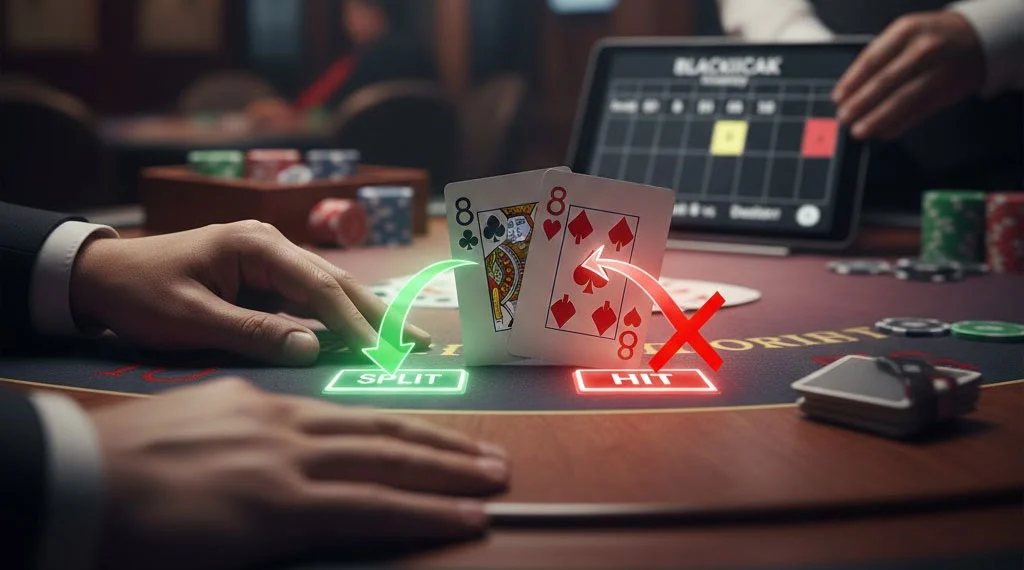
There is an almost universal rule: always split aces and eights. Because of the number of picture cards in a deck, your chances of getting 21 with your split hands is pretty good.
Eights are split not because they have great potential of winning, but because 16 is a lousy total to play with.

There are tables available online that can teach you when to split, when to stick and when to hit. It?s useful to memorise these guidelines if you?re playing in a physical casino, whereas you can always have them open in another window when you?re playing online.

Written by Alex Corcoran, online bingo fan, gaming expert and online features writer, specialising in casino games such as poker, craps and Blackjack.

Blackjack: Splitting Tens

Splitting TensOne of the most exciting ? and daunting ? experiences at the Blackjack table is when the dealer hands you a pocket pair. Let us talk about the daunting feeling first.

Unless you are a hardened gambler, the thought of doubling your outlay on a single bet can sometimes be a worrying one.

Luckily, for most players, the added incentive of the potential for a double windfall eases that worry slightly.

Either way, it is an exciting time, so let us have a look at the act of splitting pocket pairs, as we concentrate on pocket tens.

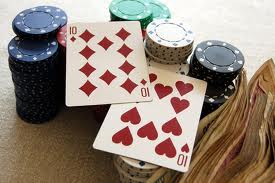
Splitting pocket tens is not a very profitable play, and this is because your score of 20 is mathematically more likely to beat the dealer. The dealer would have to draw Blackjack to beat you, or draw a 20 for the split.

So, for the recreational player, it is always better to stand on pocket tens. The card counter does have a slight advantage if they know that the deck is loaded with high cards, but this is still the far riskier play than just simply standing.

20 is one of the strongest hands you can ever hold in Blackjack, so, when you receive pocket tens, you have already reached your goal of drawing either 21 or a hand as close to 21 as possible.

If you are playing at a table where you notice someone splitting pocket tens, then it is safe to assume that they are a recreational player.

You are not playing against the player but their actions still have a direct impact on the cards you receive.

For some players, this does not matter but for others it can drive them insane, as the recreational player splits pocket tens and picks up a card that would have made you 21, should they have stood on their original 20.

Become an online blackjack winner on intercasino.com.