
Search Results for: wing

Privacy Policy

BigStackBlackjack.info takes your privacy seriously. This privacy policy describes what personal information we collect and how we use it.

Routine Information Collection

All web servers track basic information about their visitors. This information includes, but is not limited to, IP addresses, browser details, timestamps and referring pages. None of this information can personally identify specific visitors to this site. The information is tracked for routine administration and maintenance purposes.

What we collect

We may collect the following information:

  • name and job title
  • contact information including email address
  • demographic information such as postcode, preferences and interests
  • other information relevant to customer surveys and/or offers

What we do with the information we gather

We require this information to understand your needs and provide you with a better service, and in particular for the following reasons:

  • Internal record keeping.
  • We may use the information to improve our products and services.
  • We may periodically send promotional emails about new products, special offers or other information which we think you may find interesting using the email address which you have provided.
  • From time to time, we may also use your information to contact you for market research purposes. We may contact you by email, phone, fax or mail. We may use the information to customise the website according to your interests.

Security

We are committed to ensuring that your information is secure. In order to prevent unauthorised access or disclosure, we have put in place suitable physical, electronic and managerial procedures to safeguard and secure the information we collect online.

Cookies, Web Beacons And How We Use Them

Where necessary, BigStackBlackjack.info uses cookies to store information about a visitor’s preferences and history in order to better serve the visitor and/or present the visitor with customized content.

Advertising partners and other third parties may also use cookies, scripts and/or web beacons to track visitors to our site in order to display advertisements and other useful information. Such tracking is done directly by the third parties through their own servers and is subject to their own privacy policies.

Overall, cookies help us provide you with a better website, by enabling us to monitor which pages you find useful and which you do not. A cookie in no way gives us access to your computer or any information about you, other than the data you choose to share with us.

You can choose to accept or decline cookies. Most web browsers automatically accept cookies, but you can usually modify your browser setting to decline cookies if you prefer. This may prevent you from taking full advantage of the website.

Controlling Your Privacy

Note that you can change your browser settings to disable cookies if you have privacy concerns. Disabling cookies for all sites is not recommended as it may interfere with your use of some sites. The best option is to disable or enable cookies on a per-site basis. Consult your browser documentation for instructions on how to block cookies and other tracking mechanisms.

Contact Information

Concerns or questions about this privacy policy can be directed to webmaster@bigstackblackjack.info for further clarification.

Links to other websites

Our website may contain links to other websites of interest. However, once you have used these links to leave our site, you should note that we do not have any control over that other website. Therefore, we cannot be responsible for the protection and privacy of any information which you provide whilst visiting such sites and such sites are not governed by this privacy statement. You should exercise caution and look at the privacy statement applicable to the website in question.

Controlling your personal information

You may choose to restrict the collection or use of your personal information in the following ways:

  • whenever you are asked to fill in a form on the website, look for the box that you can click to indicate that you do not want the information to be used by anybody for direct marketing purposes
  • if you have previously agreed to us using your personal information for direct marketing purposes, you may change your mind at any time by writing to or emailing us at questions@bigstackblackjack.info

We will not sell, distribute or lease your personal information to third parties unless we have your permission or are required by law to do so. We may use your personal information to send you promotional information about third parties which we think you may find interesting if you tell us that you wish this to happen.

You may request details of personal information which we hold about you under the Data Protection Act 1998. A small fee might be payable. If you would like a copy of the information held on you please write to questions@bigstackblackjack.info or complete the form below.

If you believe that any information we are holding on you is incorrect or incomplete, please email us as soon as possible, at the above address. We will promptly correct any information found to be incorrect.
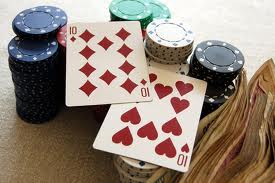
Blackjack: Splitting Tens

Splitting TensOne of the most exciting ? and daunting ? experiences at the Blackjack table is when the dealer hands you a pocket pair. Let us talk about the daunting feeling first.
Unless you are a hardened gambler, the thought of doubling your outlay on a single bet can sometimes be a worrying one.

Luckily, for most players, the added incentive of the potential for a double windfall eases that worry slightly.

Either way, it is an exciting time, so let us have a look at the act of splitting pocket pairs, as we concentrate on pocket tens.

Splitting pocket tens is not a very profitable play, and this is because your score of 20 is mathematically more likely to beat the dealer. The dealer would have to draw Blackjack to beat you, or draw a 20 for the split.

So, for the recreational player, it is always better to stand on pocket tens. The card counter does have a slight advantage if they know that the deck is loaded with high cards, but this is still the far riskier play than just simply standing.

20 is one of the strongest hands you can ever hold in Blackjack, so, when you receive pocket tens, you have already reached your goal of drawing either 21 or a hand as close to 21 as possible.

If you are playing at a table where you notice someone splitting pocket tens, then it is safe to assume that they are a recreational player.

You are not playing against the player but their actions still have a direct impact on the cards you receive.

For some players, this does not matter but for others it can drive them insane, as the recreational player splits pocket tens and picks up a card that would have made you 21, should they have stood on their original 20.

Become an online blackjack winner on intercasino.com.

Simple But Helpful Online Blackjack Tips

Blackjack TipsBlackjack is one of the simplest and most popular types of online casino games out there. Even though there are a few different variations of the game, the basics are more or less the same.

There are a lot of different strategies used by players, but everybody has their own style of playing. Whether you?re a newcomer to online blackjack or a seasoned pro, there are some tips that might help you out.

  • Learn the rules of all the online blackjack games you?re going to play. You should then practice and play for free before you?re comfortable with the idea of playing for real money.
  • You should come up with a playing limit or budget and make sure you stick with it. You?re going to have good days and bad days so know when to call it a day.
  • Check out all of the online tournaments, promotions, and bonuses that are offered at various online casinos. This will help you get the most out of your money.
  • It?s important that you don?t give out any of your personal account information to anybody that you don?t know and trust.
  • Try to learn all of the terms related to the online blackjack games so you understand what?s happening during the action.
  • Withdraw at least half of your winnings after you win a big amount. This will help stop you from playing it right away and you?ll leave the game with some winnings.
  • Try to get your cards as close to 21 as possible instead of trying to beat the dealer. If the dealer has a high card showing don?t let it distract you.
  • Don?t forget about betting cycles in online blackjack. You should bet more when you?re winning and less when you?re losing.
  • Remember, online blackjack favours the dealer. If you both go over 21, you lose.
  • If the dealer has to take a card on hands that are 16 and lower, you won?t win with less than 17 unless the dealer goes over 21.
  • Remember that an ace can be used as either one point or 11 points.
  • If your cards total 10 or lower you should take another card as you won?t be in jeopardy of busting. The most you can get is an ace to total 21, which of course is what you?re aiming to do.

Written by Alex, a blackjack aficionado who enjoys blogging about her casino experiences. She loves detailing her wins and losses for the amusement and entertainment of others!

Play Blackjack Professionally

If you don’t have much Blackjack experience, it can be daunting stepping up to the tables for a game. You can, however, hide the fact of your inexperience very simply by remembering these straightforward rules. (Note – the rules of BlackJack will differ from area to area and from casino to casino, but the general principles are the same. When in doubt, ask!). A typical BlackJack table seats a dealer and up to 7 players. Starting with the dealer, the first seat on his left is ‘1st Base’, while the first seat on his right is referred to as 3rd Base. In front of each player’s seat is a betting square, printed on the felt. Right in front of the dealer is the chip tray, while on his left is the deck (a.k.a. shoe) and next to that is the’ minimum bet sign’, which tells you how ‘expensive’ the table is. As a beginner, you will want to stick to the low bet tables to keep any losses under control. On the dealer’s right is a money drop slot. This is a security feature – casinos don’t really trust their employees, and all cash and chips are deposited here to prevent ‘leakage’.

Next to the drop slot is what’s known as the ‘discard tray’. Play starts after the dealer shuffles the cards, the deck is ‘cut’ by a player using a ‘marker card’ (NOT the bare hand), and finally the dealer ‘burns’ a card (or throws it away in order to ensure randomness). Before the cards are dealt, you make your bet by placing chips or cash into the betting box. Be aware that you can sit out a hand or 2 if you like – maybe you need a break, or the dealer is just on a lucky streak. Note that if the casino is busy, you may be asked to give up your seat so another punter can take your place (or alternatively resume the game yourself). If you really don’t want to play, just get up and vacate the seat – you can always come back later!

When all players who want to play in this round have placed a bet, 2cards will be dealt to each player going from left to right. Some casinos deal the cards face down. Elsewhere the cards are dealt face up, in which case NEVER touch them – the assumption if you do is that you are cheating! The dealer deals himself 2 cards – 1 down and 1 up. Card values are, as everyone knows, 10 Jack Queen and King are worth 10, an Ace is worth 1 or 11, all other cards are worth their face values. In noisy casinos, be prepared to use hand signals to indicate whether you want to hit or stand.

How do you indicate ‘hit’? If the cards are dealt face down, flick the cards gently across the felt 2 times. If the cards were dealt face up, point at the cards with your finger in a jabbing style. You can nod your head to emphasize the desire for a hit. If you’d prefer to stand, move your hand horizontally from left to right (palm down) to indicate ‘no’. Always keep your hands a few inches off the table to avoid suspicion. If you like, you can emphasize the stand by shaking your head ‘no’ at the same time.

Should you play single or multiple deck games? Only in Vegas do they still play single deck, and the tables are usually full – it is much easier for amateurs to ‘count’ in a single game, and keep the odds pretty fair, which explains their popularity. Multiple deck games will usually be based on even number of decks (up to 8 decks in the shoe at a time). Multiple decks allow the dealer to deal more hands per hour (less shuffling etc), which makes them more profitable for the casino, and they reduce the chances of a player ‘counting’. Dealers HAVE to follow straightforward rules, and must hit if they have 16 or less. On the other hand, if the dealer has 17 or more, he MUST stand, except in some smaller casinos, where he can hit on a ‘soft 17’.

You as the player can do anything you like, standing or hitting as it suits you. If you get a BlackJack (an Ace and a ten right off) you win 1 and a half times your bet. You can only double down on 2 card hands totaling 9, 10, or 11 (a very few casinos allow doubling on any 2 card hand). If your cards were dealt face down and you want to double, turn them over and put them on the dealer’s side of the betting square. Otherwise point to them and say ‘double’ when it’s your turn. You will have to put an equal amount of chips next to those already in the betting box (NEVER put new chips on top of old chips – it looks like cheating!). You will get one new card.

Splitting is kind of similar – cards dealt face down need to be turned over and placed them a little apart. Otherwise point at them and say ‘split’ when it’s your turn. Place an equal amount of chips in the betting box near the other card (remember, NEVER on top). You are now playing 2 hands exactly as normal (unless you just split two aces in which case you only get one card – a 10 would be good!. If it is a 10 the hand isn’t a BlackJack, meaning you only get the standard odds of 1/1 and not 1/1.5 as you would for a ‘natural’ BlackJack. Be careful how you split – it is possible to end up with 4 or 5 hands simultaneously! Likewise, it’s probably not good to split two 5s – you will be replacing a hand that is great for drawing on or doubling down on with (probably) 2 poor hands. Insurance only happens when the dealer’s face up card is an Ace, when the dealer will ask the players if they want insurance (he won’t know what his face down card or ‘hole’ card is at this point, so you won’t be able to read his expression for clues). Insurance means that half the player’s bet is placed on the ‘insurance’ semicircle printed on the felt. If the dealer gets a BlackJack the player wins the the insurance bet but loses the original bet meaning a zero hand because insurance pays 2 to 1. If the dealer does not get BlackJack, the insurance bet is lost and the hand is played normally with the remaining half bet. Don’t bother with insurance unless you are trying to card count (take it when the number of non ’10’ cards to 10s drops below the 2 to 1 margin). You may also come across ‘Surrender’ – it’s not widely used, but there are 2 versions you may find, ‘early surrender’ and ‘late surrender’.

Early surrender means quitting on 2 card hands if you don’t like the dealer’s up card (e.g. a ten or court card). Surrendering in this way will give you a small extra advantage whcih is why casinos don’t like it. Late surrender means waiting until the dealer checks for BlackJack, at which point if he doesn’t, you may decide to surrender. As we say, not very common, so ask before joining the table whether you can or not. And that’s it! Stay cool, and don’t panic, and nobody will guess you are a casino newbie!

Don?t Make These Mistakes

All blackjack players make mistakes, even experienced card-counters. But there are some innocent mistakes that rookies seem to make on a regular basis that it’s better not to make, especially if you’re playing for the first time at an actual land-based casino.

The blackjack mistake I’m most guilty of is sitting down and trying to play at a higher limit table than I have a bankroll for. It probably happens consistently all night long that players sit down and try to make $5 or $20 bets at a $100 minimum table. The dealers and other players get understandably frustrated when this happens. The solution to preventing this mistake? Just have a look at the little sign on each table stating the table limits, and make sure it’s the right stakes table before you sit down.

Another common mistake is throwing chips haphazardly into the betting circle. Your chips should always be in a single stack, so the dealer doesn’t have to get confused about whether or not you’ve doubled down. Related to this mistake is handling your bet after you’ve placed it. Dealers will snap at you over touching your bet, because they need to make sure you’re not adding chips to your bet when you have a good hand, or removing bets when you’ve got a bad hand.

Don’t touch the cards in a face up blackjack game. Cheaters will often try to mark the cards with a sharp fingernail, and the rule for not touching the cards prevents this. Be careful when handling the cards in a face down game too, because if you’re careless with the cards, you can expect correction from the dealer rather quickly.

Playing live blackjack is a lot of fun, but it’s a lot more fun when you avoid these common and sometimes embarrassing rookie blackjack mistakes.

Randy Ray

Basic Strategy Play

Since the essential features of basic strategy were developed, a number of refinements have given us the current optimal set of principles for standing, hitting, doubling, splitting, and surrendering. These, along with the other more sophisticated forms of play were worked out by using Monte Carlo techniques based on the analysis of literally billions of hands. If I tell you that you should hit a total of 16 against a dealer’s 7, there is no specific mathematical proof behind this recommendation. It emerged from an analysis of the several million times this situation emerged in the Monte Carlo analysis of the game. Hitting a 16 against a 7 loses less often than standing. Sure, following this advice produces a bust on a lot of these hands, but analysis shows, utterly compellingly, that if you don’t hit his hand you are more likely to get beat by a higher total — like 17.
When possible, I will give a logical analysis of particular aspects of basic strategy, but there are going to be situations where the reader is just going to have to accept the outcomes of the Monte Carlo analysis. The following description of basic strategy is based on the multi-deck game found in several Atlantic City and Las Vegas casinos, where the dealer stands on a soft seventeen, pairs may be re-split once, doubling down is permitted after a split, and the player may double down on any two cards. Other games require some minor adjustments that I’ll note where appropriate. However, you should never give up an edge against the casino. I highly recommend playing only where the rules are more favorable to the player.

Is Blackjack a ?Winnable? Game?

When blackjack first became a casino staple, it was assumed that it was rather like baccarat, where the house, by virtue of the rules determining play, had a statistical edge. All players and students of the game assumed that this advantage existed based on two simple facts. One, the player had to act first. Two, all busts (hands totaling over twenty-one) were losers no matter what the dealer later drew. These two rules seem to give the house an incontrovertible edge.
Conventional began to change in 1956 when a paper by Baldwin, Cantey, Maisel, and McDermont was published in the _Journal of the American Statistical Association_. This paper and a black-jack strategy manual published by Baldwin et al. the following year both attracted very little interest among non mathematicians, but it would prove to be the first step toward determining that blackjack is a “winnable” game.
Edward O. Thorp, a scientist at MIT, did understand the implications of the work of Baldwin and his colleagues and began to ex-amine two elements of the game that were previously unexamined. One, the composition of a deck of cards changes with every card dealt. Two, some deck compositions favor the player and other favor the house. In 1962, Thorp published his now famous book, _Beat the Dealer_, which contained a simple yet profound mes-sage. Unlike dice, roulette wheels, and slot machines, decks of cards have “memory.”
Blackjack, unlike Roulette for example, is a winnable game be-cause of this “memory.” Let’s look at an example. You are sit-ting at the Roulette table and the dealer throws the ball and it comes to rest on the number 9. Now, when he throws the ball again for the next round, what are the odds the ball lands on 9 again? Assuming the wheel is not rigged or the dealer is not trained to “fix” the outcome, the odds of the ball landing on 9 again are exactly the same! Let’s take it a step further. Assume that the ball does indeed land on 9 again – twice more. Now the ball has landed on the 9 three times in a row! What are the odds this happens a fourth time? Exactly the same! There is no statistical reason that the ball should “avoid” landing on 9 again.
Blackjack is different. Let’s look at a similar situation in blackjack. You are at the table with two other players. The dealer deals a 9 to each of the players at the table. Now the odds of dealing another 9 have been significantly reduced. In a six deck game the odds have been reduced from 3:49 to 7:104. This fact alone makes blackjack a winnable game.