
Search Results for: Ron

Disclaimer

Please read this important information before gambling at any online casino as it is your responsibility to ensure online gambling is legal in your country of residence.

  1. Gambling – This site disclaimer is for online casino and general gambling information purposes. You can not gamble on this site.
  2. Information – We will attempt to keep all our information up to date. The online casinos do, however make changes to their bonus offers and terms and conditions. No online casino will be bound by the terms of an outdated advertisement or promotion, we cannot be held liable for having any outdated information on this site. We strongly advise that you check through the casino site before playing to ascertain the casinos current terms and conditions.
  3. Legality – Gambling may be illegal in certain jurisdictions or countries. We cannot determine the legal status of online gambling for each site visitor. We would suggest that you check with your local authorities before gambling online. We also have no control as to the Registration, Country, jurisdiction, location of any person/s who partake in online/interactive gambling.
  4. South African Online Gambling – The current status is that interactive gambling from within the Republic of South Africa is illegal. Whilst we promote the Rand currency – this is for players outside of South African borders wishing to gamble in Rands. Furthermore – In terms of the Exchange Control Rules, it is illegal for South African residents to participate in foreign lotteries, sweepstakes and betting organizations.
  5. South African Rand Currency – Our advertising of the South African Rand (Zar) currency is intended for those countries trading/utilising the South African Rand (Zar) currency and for use by person/s outside of South African Borders. The Rand (Zar) currency is not for use by person/s residing in South Africa to partake in online/interactive gambling.
  6. South African Free Play Registration – You can register for free play as entertainment purposes only, you can not deposit money. Inorder to register for Free Play, you still need to download the casino software and complete the Free Play registration.Media informs you that the new proposed bill to regulate online gambling in South Africa will be submitted to the State President for signing. Once the State President has signed, online gambling will then be legal and regulated in South Africa!The only legal forms of gambling in South Africa as per the National Gambling Board notice number: 002/2007 – 16 April 2007 are the following:
    1. Betting/wagering with licensed operators.
    2. Online betting or wagering is permitted with licensed operators.
    3. Bingo conducted by licensed operators within the Republic.
    4. Casino land based gambling conducted by licensed operators within the Republic.
    5. Limited payout machines conducted by licensed operators.
  7. Age – It is illegal for persons under 18 years of age to gamble.
  8. Player Identification – This site www.bigstackblackjack.info, in accordance with all Online Casinos privacy policy/terms and conditions, does not obtain or have any access to any player/s identification or casino account details. This is private information kept by the casino only.
  9. Gambling Problem – There are a number of signs that indicate problem gambling. One of The biggest signs is when you find yourself losing more than you can afford to lose. Your online casino can help by locking your account, (you can email them to request this ) If you think you may have a problem, find the support you need at the links below:
  10. Liability – We have used whatever means we have at our disposal to try and list only those casinos who have the ability to honor their commitments. We don?t have insight into their financial status and thus will not be held liable for their actions.
  11. Arbitration – We are totally independent to any of the online casino/s, nor do we have any ownership or share holding/s with any online casino/s. Should you experience difficulty in your dealings with any of the casinos listed, we will happily provide whatever support at our disposal in an effort to resolve your dispute.
  12. Casino Rules – We remind you that online casinos have terms and conditions/rules and that it is your responsibility to familiarize yourself with the casinos rules before playing there.
  13. Welcome Bonus – Most online Casinos offer new players a welcome bonus. There is a play through requirement that the player must play before the player may cash in. The play through requirement will vary from casino to casino, we therefore advise you to read all terms and conditions including any terms and conditions relating to play through requirements.

In case you’re interested in knowing more info on online slots, stop by www.casinobonusmaster.com
Privacy Policy

BigStackBlackjack.info takes your privacy seriously. This privacy policy describes what personal information we collect and how we use it.

Routine Information Collection

All web servers track basic information about their visitors. This information includes, but is not limited to, IP addresses, browser details, timestamps and referring pages. None of this information can personally identify specific visitors to this site. The information is tracked for routine administration and maintenance purposes.

What we collect

We may collect the following information:

  • name and job title
  • contact information including email address
  • demographic information such as postcode, preferences and interests
  • other information relevant to customer surveys and/or offers

What we do with the information we gather

We require this information to understand your needs and provide you with a better service, and in particular for the following reasons:

  • Internal record keeping.
  • We may use the information to improve our products and services.
  • We may periodically send promotional emails about new products, special offers or other information which we think you may find interesting using the email address which you have provided.
  • From time to time, we may also use your information to contact you for market research purposes. We may contact you by email, phone, fax or mail. We may use the information to customise the website according to your interests.

Security

We are committed to ensuring that your information is secure. In order to prevent unauthorised access or disclosure, we have put in place suitable physical, electronic and managerial procedures to safeguard and secure the information we collect online.

Cookies, Web Beacons And How We Use Them

Where necessary, BigStackBlackjack.info uses cookies to store information about a visitor’s preferences and history in order to better serve the visitor and/or present the visitor with customized content.

Advertising partners and other third parties may also use cookies, scripts and/or web beacons to track visitors to our site in order to display advertisements and other useful information. Such tracking is done directly by the third parties through their own servers and is subject to their own privacy policies.

Overall, cookies help us provide you with a better website, by enabling us to monitor which pages you find useful and which you do not. A cookie in no way gives us access to your computer or any information about you, other than the data you choose to share with us.

You can choose to accept or decline cookies. Most web browsers automatically accept cookies, but you can usually modify your browser setting to decline cookies if you prefer. This may prevent you from taking full advantage of the website.

Controlling Your Privacy

Note that you can change your browser settings to disable cookies if you have privacy concerns. Disabling cookies for all sites is not recommended as it may interfere with your use of some sites. The best option is to disable or enable cookies on a per-site basis. Consult your browser documentation for instructions on how to block cookies and other tracking mechanisms.

Contact Information

Concerns or questions about this privacy policy can be directed to webmaster@bigstackblackjack.info for further clarification.

Links to other websites

Our website may contain links to other websites of interest. However, once you have used these links to leave our site, you should note that we do not have any control over that other website. Therefore, we cannot be responsible for the protection and privacy of any information which you provide whilst visiting such sites and such sites are not governed by this privacy statement. You should exercise caution and look at the privacy statement applicable to the website in question.

Controlling your personal information

You may choose to restrict the collection or use of your personal information in the following ways:

  • whenever you are asked to fill in a form on the website, look for the box that you can click to indicate that you do not want the information to be used by anybody for direct marketing purposes
  • if you have previously agreed to us using your personal information for direct marketing purposes, you may change your mind at any time by writing to or emailing us at questions@bigstackblackjack.info

We will not sell, distribute or lease your personal information to third parties unless we have your permission or are required by law to do so. We may use your personal information to send you promotional information about third parties which we think you may find interesting if you tell us that you wish this to happen.

You may request details of personal information which we hold about you under the Data Protection Act 1998. A small fee might be payable. If you would like a copy of the information held on you please write to questions@bigstackblackjack.info or complete the form below.

If you believe that any information we are holding on you is incorrect or incomplete, please email us as soon as possible, at the above address. We will promptly correct any information found to be incorrect.

Blackjack: Splitting Tens

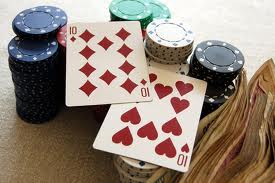
Splitting TensOne of the most exciting ? and daunting ? experiences at the Blackjack table is when the dealer hands you a pocket pair. Let us talk about the daunting feeling first.

Unless you are a hardened gambler, the thought of doubling your outlay on a single bet can sometimes be a worrying one.

Luckily, for most players, the added incentive of the potential for a double windfall eases that worry slightly.

Either way, it is an exciting time, so let us have a look at the act of splitting pocket pairs, as we concentrate on pocket tens.

Splitting pocket tens is not a very profitable play, and this is because your score of 20 is mathematically more likely to beat the dealer. The dealer would have to draw Blackjack to beat you, or draw a 20 for the split.

So, for the recreational player, it is always better to stand on pocket tens. The card counter does have a slight advantage if they know that the deck is loaded with high cards, but this is still the far riskier play than just simply standing.

20 is one of the strongest hands you can ever hold in Blackjack, so, when you receive pocket tens, you have already reached your goal of drawing either 21 or a hand as close to 21 as possible.

If you are playing at a table where you notice someone splitting pocket tens, then it is safe to assume that they are a recreational player.

You are not playing against the player but their actions still have a direct impact on the cards you receive.

For some players, this does not matter but for others it can drive them insane, as the recreational player splits pocket tens and picks up a card that would have made you 21, should they have stood on their original 20.

Become an online blackjack winner on intercasino.com.

Females in Poker

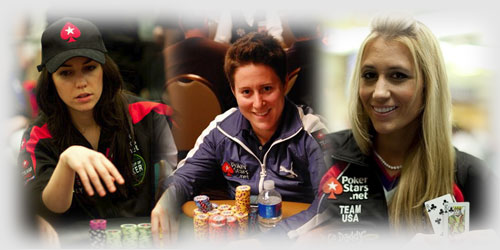
Liv Boeree, Vanessa Selbst and Vanessa Rousso

Poker is an equal opportunities game and while there may be more men at the felt than women, there?s certainly nothing stopping some women from profiting in the game. Indeed, some of the most talented players in the world are women which demonstrates that, unlike most sports, poker isn?t divided by gender.

Players such as Liv Boeree, Vanessa Selbst and Vanessa Rousso have not only proven themselves by winning million of dollars in the careers but by being students of the game; there is not one small detail they will not know about strategies and Texas holdem rules. All three are university graduates and have applied themselves to learning the art and skill of poker.

Above and beyond their capacity for playing cards, the trio have become ambassadors for the game and inspired women across the globe to learn poker.

While many women will feel intimidated at the felt by their male counterparts, the opposite is in fact true. Many male players now respect the women they face because they understand that it?s much tougher for a woman to break into the big time. Therefore, on that basis, they are much more likely to be strong player and someone to avoid playing against.

It?s true that women are a minority in the poker industry but that doesn?t mean they are the weaker sex. Indeed, some of the best players into the world are female and with more and more rising to the top it won?t be long before parity reigns in the world of bluffs, bets and bad beats.

Play Blackjack Professionally

If you don’t have much Blackjack experience, it can be daunting stepping up to the tables for a game. You can, however, hide the fact of your inexperience very simply by remembering these straightforward rules. (Note – the rules of BlackJack will differ from area to area and from casino to casino, but the general principles are the same. When in doubt, ask!). A typical BlackJack table seats a dealer and up to 7 players. Starting with the dealer, the first seat on his left is ‘1st Base’, while the first seat on his right is referred to as 3rd Base. In front of each player’s seat is a betting square, printed on the felt. Right in front of the dealer is the chip tray, while on his left is the deck (a.k.a. shoe) and next to that is the’ minimum bet sign’, which tells you how ‘expensive’ the table is. As a beginner, you will want to stick to the low bet tables to keep any losses under control. On the dealer’s right is a money drop slot. This is a security feature – casinos don’t really trust their employees, and all cash and chips are deposited here to prevent ‘leakage’.

Next to the drop slot is what’s known as the ‘discard tray’. Play starts after the dealer shuffles the cards, the deck is ‘cut’ by a player using a ‘marker card’ (NOT the bare hand), and finally the dealer ‘burns’ a card (or throws it away in order to ensure randomness). Before the cards are dealt, you make your bet by placing chips or cash into the betting box. Be aware that you can sit out a hand or 2 if you like – maybe you need a break, or the dealer is just on a lucky streak. Note that if the casino is busy, you may be asked to give up your seat so another punter can take your place (or alternatively resume the game yourself). If you really don’t want to play, just get up and vacate the seat – you can always come back later!

When all players who want to play in this round have placed a bet, 2cards will be dealt to each player going from left to right. Some casinos deal the cards face down. Elsewhere the cards are dealt face up, in which case NEVER touch them – the assumption if you do is that you are cheating! The dealer deals himself 2 cards – 1 down and 1 up. Card values are, as everyone knows, 10 Jack Queen and King are worth 10, an Ace is worth 1 or 11, all other cards are worth their face values. In noisy casinos, be prepared to use hand signals to indicate whether you want to hit or stand.

How do you indicate ‘hit’? If the cards are dealt face down, flick the cards gently across the felt 2 times. If the cards were dealt face up, point at the cards with your finger in a jabbing style. You can nod your head to emphasize the desire for a hit. If you’d prefer to stand, move your hand horizontally from left to right (palm down) to indicate ‘no’. Always keep your hands a few inches off the table to avoid suspicion. If you like, you can emphasize the stand by shaking your head ‘no’ at the same time.

Should you play single or multiple deck games? Only in Vegas do they still play single deck, and the tables are usually full – it is much easier for amateurs to ‘count’ in a single game, and keep the odds pretty fair, which explains their popularity. Multiple deck games will usually be based on even number of decks (up to 8 decks in the shoe at a time). Multiple decks allow the dealer to deal more hands per hour (less shuffling etc), which makes them more profitable for the casino, and they reduce the chances of a player ‘counting’. Dealers HAVE to follow straightforward rules, and must hit if they have 16 or less. On the other hand, if the dealer has 17 or more, he MUST stand, except in some smaller casinos, where he can hit on a ‘soft 17’.

You as the player can do anything you like, standing or hitting as it suits you. If you get a BlackJack (an Ace and a ten right off) you win 1 and a half times your bet. You can only double down on 2 card hands totaling 9, 10, or 11 (a very few casinos allow doubling on any 2 card hand). If your cards were dealt face down and you want to double, turn them over and put them on the dealer’s side of the betting square. Otherwise point to them and say ‘double’ when it’s your turn. You will have to put an equal amount of chips next to those already in the betting box (NEVER put new chips on top of old chips – it looks like cheating!). You will get one new card.

Splitting is kind of similar – cards dealt face down need to be turned over and placed them a little apart. Otherwise point at them and say ‘split’ when it’s your turn. Place an equal amount of chips in the betting box near the other card (remember, NEVER on top). You are now playing 2 hands exactly as normal (unless you just split two aces in which case you only get one card – a 10 would be good!. If it is a 10 the hand isn’t a BlackJack, meaning you only get the standard odds of 1/1 and not 1/1.5 as you would for a ‘natural’ BlackJack. Be careful how you split – it is possible to end up with 4 or 5 hands simultaneously! Likewise, it’s probably not good to split two 5s – you will be replacing a hand that is great for drawing on or doubling down on with (probably) 2 poor hands. Insurance only happens when the dealer’s face up card is an Ace, when the dealer will ask the players if they want insurance (he won’t know what his face down card or ‘hole’ card is at this point, so you won’t be able to read his expression for clues). Insurance means that half the player’s bet is placed on the ‘insurance’ semicircle printed on the felt. If the dealer gets a BlackJack the player wins the the insurance bet but loses the original bet meaning a zero hand because insurance pays 2 to 1. If the dealer does not get BlackJack, the insurance bet is lost and the hand is played normally with the remaining half bet. Don’t bother with insurance unless you are trying to card count (take it when the number of non ’10’ cards to 10s drops below the 2 to 1 margin). You may also come across ‘Surrender’ – it’s not widely used, but there are 2 versions you may find, ‘early surrender’ and ‘late surrender’.

Early surrender means quitting on 2 card hands if you don’t like the dealer’s up card (e.g. a ten or court card). Surrendering in this way will give you a small extra advantage whcih is why casinos don’t like it. Late surrender means waiting until the dealer checks for BlackJack, at which point if he doesn’t, you may decide to surrender. As we say, not very common, so ask before joining the table whether you can or not. And that’s it! Stay cool, and don’t panic, and nobody will guess you are a casino newbie!

Five Worst BlackJack Rules

Quick, can you tell me what are the five worst playing rules for blackjack? If you don’t know them then the next time you play blackjack you might just be bucking higher than normal odds. So let’s review these bummers to be sure you never play in a game that has them.
Blackjacks pay Even Money

This one stinks. Normally the casino pays 3 to 2 when a player gets a blackjack hand (and the dealer doesn’t also have blackjack). Getting paid 1 to 1 may not seem like a big deal but it is because the casino’s edge goes up by 2.3% (ouch).

Normally blackjack games that offer an even money payoff also have several other player favorable rules as a come on. A good example is SuperFun 21, which is offered in many casinos in Las Vegas. The game uses only a single deck of cards with liberal rules such as surrendering anytime including after hitting, doubling, or splitting. But the liberal rules do not come close to negating the 2.3% edge the house enjoys when it pays even money on blackjack hands. The bottom line is be very cautious when a casino only offers even money on a blackjack.
Blackjack pays 6 to 5

Oh come on, no casino would pay 6 to 5 for a blackjack hand you say? Well guess what? Walk up and down the strip in Las Vegas and you’ll find this game all over the place. The come on is that it’s advertised as a single deck game, which usually implies a good game for the player. But getting paid 6 to 5 on a blackjack is a much worse deal than getting paid the normal 3 to 2. How much less? For every $10 you bet and get a blackjack you’ll get paid $3 less. This increases the house edge by 1.2%.

What’s ironic is that these same casinos that offer this 6 to 5 abomination game also offer plenty of multiple deck games with a much lower house edge (partly because blackjacks are paid at the standard 3 to 2). Yet the last time I visited Las Vegas I observed all the 6 to 5 single deck tables packed with players while the multiple deck tables where much less crowded. I finally asked one player who had quit playing the 6 to 5 single deck payoff game why he choose to play it rather than the better multiple deck game. His response was that he thought 6 to 5 was a better payoff than 3 to 2. So much for the math skills of the average blackjack player (which is probably why the casinos in Las Vegas are blazingly getting away with offering this game to clueless tourists).
Doubling Down only on 11 or 10 or just 11

Often you’ll see this rule in single deck games where a player is restricted to doubling on a two card 10 and 11 (or just 11). This means you can’t double down on 9 or any soft hand (that’s not good). The house edge goes up by about 0.7% when you can only double on 11 and by 0.25% when you are restricted to just doubling on only 10 and 11.
Using 8 decks of Cards

Compared to a single deck game, the casino’s edge increases by 0.61% when 8 decks of cards are used. You would need several liberal rules to offset the 0.61% edge to make the game playable. At the minimum make sure the dealer stands on soft 17 and doubling after pair splitting is offered (ideally also late surrender).
Dealer Hits Soft 17

Many casinos (especially on the Las Vegas strip) have changed the dealer rule regarding soft 17. It used to be pretty standard that dealers must stand on all 17 hands (which includes a soft 17 hand). Nowadays, however, more casinos are changing to hit soft 17. That’s not a good change for the player because the casino edge increases by 0.20%. Given a choice you are better off playing where the rules require that dealers must stand on soft 17.

Probably the worse blackjack rule that I ever saw was dealer winning all ties. Yes, I know that’s the way you play it with your buddies when you get together for a friendly game of blackjack and poker. But in a casino, you should never play any blackjack game where the dealer wins ties. The standard casino rule is when your hand totals 21 or less and the dealer ends up with the same total, it’s a tie or push and you don’t lose or win your bet (but remember that a dealer blackjack hand beats a player’s three or more cards 21 hand). By winning tied hands the casino edge zooms by about 9%.

There are two things to keep in mind when you play blackjack. First, there has never been a game with exotic rules that has a lower house edge than the standard game. So before you decide to try a SuperFun 21 or other ‘new’; game you better check the rules.

Secondly, you should always try to pick your games carefully so that the overall mix of rules leads to a casino edge that’s as low as possible for the game you are playing (this of course assumes you know the basic playing strategy – if not, learn it!).

Dan Pronovost showed the effect of each rule on the house edge in his excellent article, Picking the Right Game, that appeared in issue #35 of the Blackjack Insider Newsletter (www.casino.com/newsletter/blackjack/archive/). This article is a good starting point to be sure you understand the impact a rule has on the house edge.

Often casinos will introduce new rules or games in their blackjack pits. An example is the new game Blackjack Switch, which recently had a trial run in Atlantic City and will soon be launched in casinos there and in Las Vegas (it’s also offered on the Internet). In this game you must play two hands and you are allowed to switch the two top cards. That very favorable player rule is offset by this new rule – when the dealer has 22, all player hands of 21 or less push (instead of win). So is the favorable switch rule offset by the very unfavorable push 22 rule? The answer is I don’t know at the moment but I’ve got several blackjack mathematicians working on this as we speak to determine the overall impact on the player (we hope to have it all unraveled in the next issue of the Blackjack Insider Newsletter).

That’s it for now. Stay positive and make sure you know the rules before you play.

By Henry Tamburin

How to Play Blackjack

The game itself is simple. You, the player, attempt to accumulate cards with a numerical total closer to (but not more than) twenty-one than those accumulated by the dealer. If you do so, you win. If the dealers’ total is closer to twenty-one than yours, you lose. Winning hands are paid off at even odds. If you and the dealer both arrive at the same total, the hand is a “push,” and nobody wins. All bets must be made before any cards are dealt, and no bet may be changed once the first card has been dealt.
Each player is initially dealt two cards; they may be face-down or face-up, depending on the rules of the casino. The dealer gets two cards, one face-up and one face-down. The value of the cards is given by their face value except that the ace (A) counts as either 1 or 11 and the 10, jack (J), queen (Q), and king (K) all count as 10.
The combination of an A and any 10 on the first two cards is a blackjack and is an automatic winner (unless both dealer and player have it, in which case it’s a push). A player blackjack is paid at 3 to 2. When the house has a blackjack the player merely loses his bet and not one and a half times that bet. Any combination of cards that exceeds 21 is a bust and a loser. The player always goes first, so if the player’s total exceeds 21 the hand is lost — even if the dealer also busts later. If the dealer busts, all remaining players are winners. The dealer has no options; play is fixed by the rules.
After the first two cards are dealt, the player must decide whether or not to take additional cards based on two pieces of information: the cards held and the dealer’s upcard. This is where the game begins to get interesting. A wide variety of options offer themselves, and unless the player understands the principles of the game there are numerous ways to go wrong. Let’s review the options first; correct play will be discussed later.

Counting Cards

Many inexperienced players have a misconception about card counters as mathematical geniuses who can keep track of every card in a multiple decks of cards. While there may very well be people who can do this kind of thing, card counting is not about keeping track of every card. The idea behind counting cards is to keep track of the players statistical likelihood of winning a hand and then adjusting betting and playing accordingly.
The idea behind card counting is simple gambling strategy. Any professional gambler will tell you that the way to win at gambling is to bet more when you have the advantage and bet less (or not at all) when you do not. It is that simple. In black-jack, certain cards remaining in the deck are good for the player and certain ones are not. If you “count” these cards, you will always know when you have the advantage.
Edward O. Thorp’s work confirmed that 10’s and A’s remaining in the deck were good for the player, while 5’s and 6’s remaining in the deck were bad for the player. He worked out the circumstances under which particular combinations of cards remaining in the deck gave the player and advantage over the house. He also presented the first two card-counting systems, Thorp’s five-count and Thorp’s ten-count. The latter, which is more powerful, was based on determining the ration between 10’s and non-10’s remaining in the deck. Card counting was born from irrefutable logic: Keep track of the cards: make small bets when the deck favors the house and large bets when it favors the players.
Thorp’s analysis was later improved upon by the work of many others, notably Julian Braun, Lawrence Revere, Peter Griffin, Stanford Wong, Ken Uston, Arnold Snyder, and Lance Humble. Today the game is understood at a rather deep level, and sophisticated systems exist that give the knowledgeable player a distinct edge over the house.
Which Cards Matter?
The object of card counting is to keep track of cards that are advantageous to the player. The simple question is, then, “which cards matter?”
The card most beneficial to the player is the 10. 10’s are ad-vantages to the player for several reasons. One, they will cause the dealer to bust since he is required to take cards based on the rules of play. He may not take other factors into account while playing (like you do!). Two, they turn hands that you double down on into very strong hands (which is why you double down on those hands, by the way). Three, they are used to create blackjacks. Remember that blackjacks are more beneficial to the player since getting one pays 3 to 2 but losing to one only costs the original bet! Another important card for the player is the A. Aces present soft doubling (and hitting) opportunities and they create blackjacks. Remember – blackjack is more important to the player than the house!
The worst cards for the player are the 5 and the 6 (and 2, 3, and 4 to a lesser degree). The reason these are not good for the player is simple – they are beneficial to the house. Since the house is forced by the rules of play to take cards on any hand lower than 17, the 5 and the six present the possibility of very strong hands for the dealer (remember that 10’s are not advantageous to the dealer since they make “busts” of these hands).
Before we begin to learn how to count we should talk about how this will help us. You should remember that the purpose of counting is to know when the player has an advantage and when he does not. This knowledge will do nothing for you unless you do something with it. What you want to do is adjust your betting and your play based on your advantage.
Adjusting Your Bets
Adjusting your bets is very straightforward. When the composition of the deck is in your favor, you bet more. When it is not, you bet less. Very simple. Learning just this can give you as much as a 2% advantage against the house. If that advantage does not sound like much, keep in mind that many casino slot machines only produce a 2 – 3% advantage for the casino and that is enough to make billions of dollars of profit for the casino. Granted, this is at a much higher volume than you will play at but remember that bet sizes are much smaller.
Adjusting Your Play
Learning to adjust your play based on deck composition is not an easy task, but the rewards are phenomenal. Taking this step can increase your advantage by another 2% for a total of 4% against the house. The good news is that you can learn this with a lot of practice. The principles are simple but mastering this level of play takes many hours of practice.
An expert card counter will adjust play in many different ways depending on the composition of the deck. It is common for an expert card counter to do things that “break the rules” of basic strategy like:
1. Standing earlier if the deck is very 10 rich — if the dealer can bust, so can you!
2. Standing later if the deck is very 10 poor.
3. Splitting 10’s when the deck is extremely 10 rich.
4. Doubling down on A, 9 when the deck is extremely 10 rich.
Of course, the most important play adjustment can be deciding when to start playing at a table and when to stop.

Hit or Stand?

The guidelines for hitting are rather straightforward. If the dealer shows a 2 or 3, you continue to take a hit until you have a hard 13 or a soft 18. If the dealer shows 4, 5, or 6, you continue to take a hit until you reach a hard 12 or a soft 18. If the dealer shows 7 or 8, you continue to take a hit until you have a hard 17 or a soft 18. It the dealer shows anything higher than 8, you continue to take a hit until you have a hard 17 or a soft 19.

Dealer Shows Hit Until You Have
2 or 3 hard 13 or soft 18
4, 5, or 6 hard 12 or soft 18
7 or 8 hard 17 or soft 18
9, 10, or A hard 17 or soft 19

Though there is no mathematical “proof” of these principles there is actually some simple logic to them. Don’t forget that you are also playing the odds based on billions of simulations of blackjack hands. Let’s look at some of the logic.
? If the dealer shows a 7 or above, then the most likely two-card total is 17 or above (with a 10 or an A in the hole), so you are going to have to take a card on any total under 17 or likely lose.
? When the dealer shows a card less than 7, the two-card total will likely be less than 17 (it can be exactly 17 with a 6 and an A), and the dealer will be forced to take another card. Since there are more 10’s in the deck than any other denomination, the dealer will have a fairly high probability of busting and you will win.
? If you were to take a card with a total between 12 and 16 you would be likely to bust. In situations like this the proper play is to let the dealer pull. If the high card shows up and there is a high card in the hole, you will win.
? Hit a total of 12 against a dealer 2 or 3. I’ve seen books that tell you to stand in these situations. They are wrong. You must take a card.
? Hit a 16 against a dealer’s 7. Many inexperienced players have trouble believing that this is the proper play but it is. Countless computer runs have proved it again and again. From the players point of view a total of 16 is no better than a total of 12; you can win with such totals only when the dealer breaks. Besides, there are still five cards that can help out a 16 (A, 2, 3, 4, 5).
? You take a card whenever you have A, 6 (unless you double down) and you hit an A, 7 against a 9, 10, or A. It’s true that you will sometimes find yourself going “backwards” and have a hand that is “weaker” than you just had. However, computer simulations consistently show that this is the proper play.
? It may come as a surprise to inexperienced players, but 18 is not a strong hand when facing a dealer 9, 10, or A.

Online Gambing Addiction – Play Safely

Can you imagine being able to place a bet with just a press of a button? Can you imagine playing and betting as long as you want?

Can you imagine gambling from the comfort of your own home?

We know for a fact that gambling is risky business, and unrestrained gambling is just asking for trouble. Compulsive gamblers already have a hard time restraining themselves from the call of casinos and bookies, and now Internet gambling just takes the ante a step further.

With Internet gambling, you don?t need hard cash. Everything that is online is so easy to access. Play Baccarat, Blackjack, Craps, Keno, Roulette or Slots. Play all day, all night.

Before the 1990s, gamblers who wanted to place a casino or sports type bet in the United States basically had two choices: they could travel to a legitimate brick-and-mortar gaming establishment or place an illegal wager through a bookie. However, with the emergence of the Internet in the mid-1990s, a new form of gambling appeared; Internet gambling through gaming casinos and sports wagering. Internet gambling can take place on any electronic device that offers Internet access anywhere on the globe.

Internet gambling makes payment options for gambling individuals easy. They can just choose from several types of payment options other than credit cards. These include:

VISA and MasterCard cards: These cards are tied directly to the cardholder’s bank account. Funds for all transactions are deducted directly from the cardholder’s bank account, but cardholders can make credit card-type transactions that do not require a personal identification number.

Private-label debit cards: These cards are similar to check cards above but are issued by private companies rather than credit card associations.

On-line payment providers: These companies send and receive funds electronically for such uses as on-line auctions and purchases.

Wire transfers: Some Internet gambling sites promote this method of payment, which allows Internet gambling customers to wire money directly from a bank account to the site.

?E-cash? or digital cash: It is a digital representation of real money that can be placed on a computer hard drive, smart card and other devices with memory. It can be purchased from an authorized provider.

Internet gambling sites also offer money orders; traveler?s checks; bank drafts; cashier?s, certified, and personal checks; and a number of other electronic banking systems or processors as payment options. With Internet gambling?s easy payment options, even a non-gambler would be tempted to try.

Statistics also show that Internet gambling has nearly doubled every year since 1997 ? in 2001 it exceeded $2 billion. It also boasts 110 sport-related Internet gambling sites.

According to the American Psychological Association, Internet gambling could be just as addictive as alcohol and drugs.

This is a confession from quoted from The Gambling Problem Talking Point website:

?? I am addicted to online poker, not to mention soccer betting and casinos whenever I am in the vicinity of one.

For the longest time I thought I had the beast under control. Thought I was smarter than the pack, and shrewd enough to beat the pack. Considered my betting to be more of an investment than anything else.

How much have I lost gambling? I am afraid to tally.

Has it ruined my life? Almost ? I guess being from a wealthy family, it helped me to cover the tracks not to mention the losses.