Search Results for: great

Maximise Potential Returns

maximize potential returns

So, you have two face cards. With a total of 20, you stand pat, right?

Maybe not. There are plenty of people who would be looking to maximise their potential return.

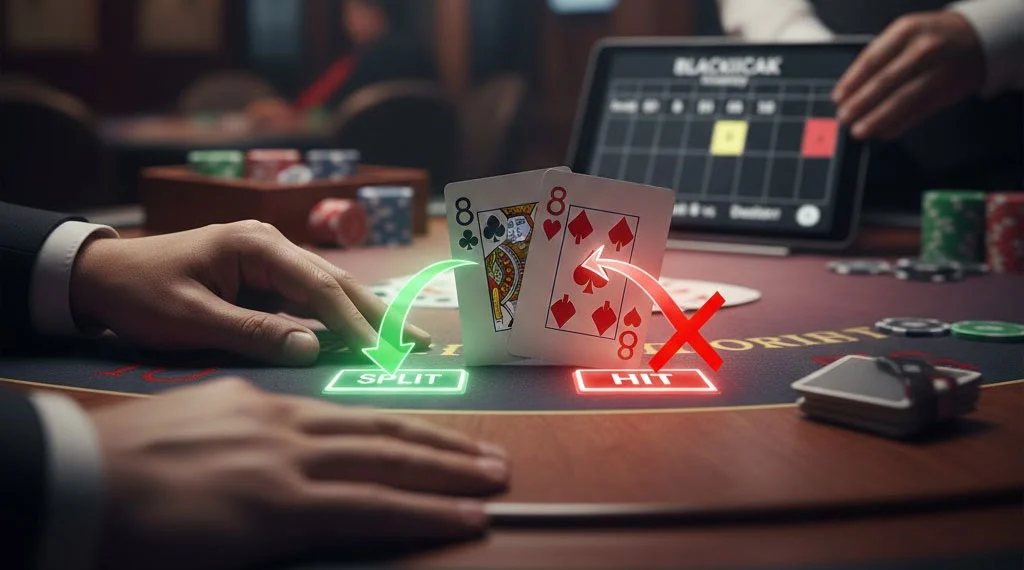
Splitting is something you can only do after you receive your two cards, and can only be done with identical cards. They don?t have to be completely identical, i.e. two queens of diamonds, just the same rank.

The player has to place a second bet, identical to the first, next to the original wager and the dealer splits the two cards to create a second hand.

Rules of splitting include that there are no blackjacks. If you draw a queen on top of an ace, it?s 21 and not blackjack so you could still end up not winning.

Another standard rule is that if you split aces, you only get one additional card for each split hand.
Just occasionally, you?ll be able to really make the most of your hand by re-splitting. If the cards of a post-split hand are also the same value, you can usually split them again and place a further wager on the new hand.

To take the first example, of drawing two picture cards, the best advice is to stick at 20, regardless of what the dealer holds. You have a good chance of winning with that hand, whereas you don?t know what you would get with the split hand.

There is an almost universal rule: always split aces and eights. Because of the number of picture cards in a deck, your chances of getting 21 with your split hands is pretty good.
Eights are split not because they have great potential of winning, but because 16 is a lousy total to play with.

There are tables available online that can teach you when to split, when to stick and when to hit. It?s useful to memorise these guidelines if you?re playing in a physical casino, whereas you can always have them open in another window when you?re playing online.

Written by Alex Corcoran, online bingo fan, gaming expert and online features writer, specialising in casino games such as poker, craps and Blackjack.

KTO Casino & Sportsbook

KTO Casino & Sportsbook first appeared on the gaming scene in 2018, and have become one of the top casinos and sportsbooks around.

Not only do they offer a great sportsbook that will impress even the most seasoned sports betting punter, but their casino offering is also not to be sneezed at!

Offering over 4000 quality casino games, ranging from video slots, table games, video poker, virtual betting & skill games all from top providers like NetEnt, Pragmatic Play, Oryx, Fugaso and many others (33 in total), players are most definitely spoilt with choice.

KTO Sportsbook

KTO’s sportsbook offering is one of best we’ve ever seen, with not only a wide range of betting markets for punters to choose from, but with some of the best odds we’ve seen at any sportsbook on the net.

Not only do they list popular events, they even have some of the less well known markets available to bet on. A few examples are League of Legends, Call Of Duty, StarCraft 2 and other massive multiplayer online games. You can even bet chess games…

What also tickled our fancy was the various views that punters can utilise. Choose between the “normal” dashboard where all the information is displayed in a four column view, Event View where an even can be chosen on the left, and all the available bets with their odds  are displayed in the center column – the bets and odds are even updated in real time as the event unfolds.

Punter who want to keep an eye on multiple events can use the Live Multiview, from here punters can “add” various events from the left panel to display in the center column, all with their latest bets and odds.

The last two views are Live Calendar and Results. The Live Calendar view displays a calendar-like view where punter can view current and upcoming events, neatly organised by date and time. Results view is where punters can go to check up on what an events outcome was – all easy filterable and sortable by using various dropdown filters.

KTO Casino Welcome Bonus

KTO Casino 1700 welcome offerKTO hasn’t kept back on their Casino player welcome bonus either – New players at the casino get up to €/$1’700 over their first 3 deposits. And with a low 25x times wagering requirement it is nothing to sneeze at. Unfortunately for us blackjack players, the welcome bonus funds can only be wagered on slots – but that’s no biggie, as the slots on offer will entice even the most hardened blackjack player.

Blackjack Games at KTO

KTO Casino offers a variety of Blackjack games that will please any blackjack player. At the time of writing this there were over 36 different blackjack games to play, ranging from classic classic Blackjack to exotics like Lucky Cat Blackjack and even a 3D Blackjack.

The blackjack games are also not all single hand blackjack games, players that can keep track of multiple hands will most definitely enjoy Habanero’s Blackjack 3 Hand or Double Exposure 3 Hand.

Think you know your Blackjack stuff – try out the Professional Blackjack Series games by NetEnt. Choose between the Low or High limit options available, and play Blackjack like a pro! Or try out the Elite Edition European or Atlantic City Blackjack by Genii for that something different.

And the best part, players can try out all of the games (be it Blackjack or any other casino game) for free without even making a deposit or wagering a cent.

KTO Live Casino

Looking for something more personal? Then try out any of the 23 Live Casino games available at KTO Casino. Interact with real live dealers while you play Lightning Roulette, Casino Hold’Em, Sic Bo and numerous Blackjack games.

Players can chat to dealers, tip them and even chat to other players when playing at multiplayer tables.

Remember that game, once started, could last a couple of days? Well, the live version of Monopoly is slightly different. In this game a host spins a supersized wheel and players have to predict where it will stop. Mr. Monopoly is ever present to award extra rolls, cash wins and multipliers.

KTO Banking Options

Deposit and withdrawing winnings at KTO casino has also never been easier. With over 36 banking options to choose, ranging from the usual Visa and MasterCard, Neteller, AstroPay, Qiwi, PaySafeCard and other well known options, to some less known ones like Bancomer, Oxxo, Banorte and Itau – chances are that the option that you prefer will be there.

Making a withdrawal is also just as quick as deposting – KTO strives to process payments as quickly as possible, and players can usually expect the payment to show in their banking account withing 12 hours. This obviously depends on the banking method used.

To Mobile or not to Mobile?

Another thing that was quite impressive – it doesn’t matter whether a player visits the KTO website via a desktop PC, laptop, tablet or mobile phone, all the features that are available for the one platform is available for the other. Their site is fully responsive and fully mobile compliant.

Create your account via a desktop PC, and play using your mobile while on the move, or just use your mobile to create an account and play. Players use the same account on all the platforms, so switching between them will still give you access to your bankroll.

KTO In A Nutshell

In the past when when looking at combination (Sportsbook and Casino) sites, it was mostly found that the operators tended to focus on either one or the other genre, with the one almost being “forgotten about” while the other was only the latest and greatest.

Not so at KTO – whether you are a sports fanatic, or a casino enthusiast, KTO will have you covered. Sports punters get all the hottest action at the greatest odds, and casino gamblers get access to 4000+ of the most popular games from only top providers.

The KTO offering is by far one of the best integrated operations we’ve come across – and we’ve seen plenty!


KTO Casino 1700 welcome offer

Gaming Widow Winners

Has your other half taken to poker or blackjack in a really big way? Does he move mountains to get to the nearest roulette table and constantly have a game on the go on his laptop and even his mobile phone? If this sounds familiar then welcome to the club ? you’re officially a gaming widow.

Don't be a gaming widowBut hey, this is not all bad news! You may enjoy a bit of time to yourself to play online bingo once in a while, but if his habit has escalated to a whole other level then as long as he is winning you are in for some great benefits. What starts out as an online pastime can quickly move into the real world if your man gets invited to big money games in person. Casino tournaments often take place in glamorous locations so pack your case, put on your sunglasses and get ready to check out the spa and the pool while he focuses on his game.

Another reason to tolerate his obsession is the pay off for you: how can he refuse your requests to head off out with the girls or hit the shops for some retail therapy when he is locked into his card games all the time? And who knows ? you may even get a share of his winnings to treat yourself with too: guilty husband equals open wallet syndrome is not to be ignored.

And finally, if you can’t beat ’em then join ’em! Women have a proven track record of success playing poker and blackjack so why not try your hand at the tables, virtual or in real time, and see how you get on. You are definitely not at a disadvantage and all his talk dissecting recent games may even have taught you a thing or too. Imagine his face if you turn out to be a better player than him!

Play Blackjack Professionally

If you don’t have much Blackjack experience, it can be daunting stepping up to the tables for a game. You can, however, hide the fact of your inexperience very simply by remembering these straightforward rules. (Note – the rules of BlackJack will differ from area to area and from casino to casino, but the general principles are the same. When in doubt, ask!). A typical BlackJack table seats a dealer and up to 7 players. Starting with the dealer, the first seat on his left is ‘1st Base’, while the first seat on his right is referred to as 3rd Base. In front of each player’s seat is a betting square, printed on the felt. Right in front of the dealer is the chip tray, while on his left is the deck (a.k.a. shoe) and next to that is the’ minimum bet sign’, which tells you how ‘expensive’ the table is. As a beginner, you will want to stick to the low bet tables to keep any losses under control. On the dealer’s right is a money drop slot. This is a security feature – casinos don’t really trust their employees, and all cash and chips are deposited here to prevent ‘leakage’.

Next to the drop slot is what’s known as the ‘discard tray’. Play starts after the dealer shuffles the cards, the deck is ‘cut’ by a player using a ‘marker card’ (NOT the bare hand), and finally the dealer ‘burns’ a card (or throws it away in order to ensure randomness). Before the cards are dealt, you make your bet by placing chips or cash into the betting box. Be aware that you can sit out a hand or 2 if you like – maybe you need a break, or the dealer is just on a lucky streak. Note that if the casino is busy, you may be asked to give up your seat so another punter can take your place (or alternatively resume the game yourself). If you really don’t want to play, just get up and vacate the seat – you can always come back later!

When all players who want to play in this round have placed a bet, 2cards will be dealt to each player going from left to right. Some casinos deal the cards face down. Elsewhere the cards are dealt face up, in which case NEVER touch them – the assumption if you do is that you are cheating! The dealer deals himself 2 cards – 1 down and 1 up. Card values are, as everyone knows, 10 Jack Queen and King are worth 10, an Ace is worth 1 or 11, all other cards are worth their face values. In noisy casinos, be prepared to use hand signals to indicate whether you want to hit or stand.

How do you indicate ‘hit’? If the cards are dealt face down, flick the cards gently across the felt 2 times. If the cards were dealt face up, point at the cards with your finger in a jabbing style. You can nod your head to emphasize the desire for a hit. If you’d prefer to stand, move your hand horizontally from left to right (palm down) to indicate ‘no’. Always keep your hands a few inches off the table to avoid suspicion. If you like, you can emphasize the stand by shaking your head ‘no’ at the same time.

Should you play single or multiple deck games? Only in Vegas do they still play single deck, and the tables are usually full – it is much easier for amateurs to ‘count’ in a single game, and keep the odds pretty fair, which explains their popularity. Multiple deck games will usually be based on even number of decks (up to 8 decks in the shoe at a time). Multiple decks allow the dealer to deal more hands per hour (less shuffling etc), which makes them more profitable for the casino, and they reduce the chances of a player ‘counting’. Dealers HAVE to follow straightforward rules, and must hit if they have 16 or less. On the other hand, if the dealer has 17 or more, he MUST stand, except in some smaller casinos, where he can hit on a ‘soft 17’.

You as the player can do anything you like, standing or hitting as it suits you. If you get a BlackJack (an Ace and a ten right off) you win 1 and a half times your bet. You can only double down on 2 card hands totaling 9, 10, or 11 (a very few casinos allow doubling on any 2 card hand). If your cards were dealt face down and you want to double, turn them over and put them on the dealer’s side of the betting square. Otherwise point to them and say ‘double’ when it’s your turn. You will have to put an equal amount of chips next to those already in the betting box (NEVER put new chips on top of old chips – it looks like cheating!). You will get one new card.

Splitting is kind of similar – cards dealt face down need to be turned over and placed them a little apart. Otherwise point at them and say ‘split’ when it’s your turn. Place an equal amount of chips in the betting box near the other card (remember, NEVER on top). You are now playing 2 hands exactly as normal (unless you just split two aces in which case you only get one card – a 10 would be good!. If it is a 10 the hand isn’t a BlackJack, meaning you only get the standard odds of 1/1 and not 1/1.5 as you would for a ‘natural’ BlackJack. Be careful how you split – it is possible to end up with 4 or 5 hands simultaneously! Likewise, it’s probably not good to split two 5s – you will be replacing a hand that is great for drawing on or doubling down on with (probably) 2 poor hands. Insurance only happens when the dealer’s face up card is an Ace, when the dealer will ask the players if they want insurance (he won’t know what his face down card or ‘hole’ card is at this point, so you won’t be able to read his expression for clues). Insurance means that half the player’s bet is placed on the ‘insurance’ semicircle printed on the felt. If the dealer gets a BlackJack the player wins the the insurance bet but loses the original bet meaning a zero hand because insurance pays 2 to 1. If the dealer does not get BlackJack, the insurance bet is lost and the hand is played normally with the remaining half bet. Don’t bother with insurance unless you are trying to card count (take it when the number of non ’10’ cards to 10s drops below the 2 to 1 margin). You may also come across ‘Surrender’ – it’s not widely used, but there are 2 versions you may find, ‘early surrender’ and ‘late surrender’.

Early surrender means quitting on 2 card hands if you don’t like the dealer’s up card (e.g. a ten or court card). Surrendering in this way will give you a small extra advantage whcih is why casinos don’t like it. Late surrender means waiting until the dealer checks for BlackJack, at which point if he doesn’t, you may decide to surrender. As we say, not very common, so ask before joining the table whether you can or not. And that’s it! Stay cool, and don’t panic, and nobody will guess you are a casino newbie!

A Simple Card Counting System

Let’s start with a very simple system. After you have mastered basic strategy play, this system should only take a couple of dozen hours play to learn but it will dramatically increase your results. This system will involve a simple count, a running count, bet progressions and a few minor adjustments to play.
First the count. Our count will keep track of 10’s and A’s on one hand and 2’s, 3’s, 4’s, 5’s, and 6’s on the other. Start by keeping a running count of your advantage or disadvantage. In the interest of simplicity we will start with a single deck. A deck of cards has 4 A’s and 16 10’s ( 4 each of 10, J, Q, and K) for a total of 20 cards that benefit the player. The deck also contains 20 cards that are advantageous to the dealer ( 4 each of 2, 3, 4, 5, and 6). As noted earlier, 5’s and 6’s are “better” for the dealer than 2’s, 3’s, and 4’s but this is a simple count. Much more sophisticated counts exists and the reader is encouraged to master this one first and then begin to look at more complex systems.

So, we know we start with a running count of zero. Twenty cards for the player, twenty for the dealer – no advantage – zero. As play begins, you will add 1 to your “count” for every 2, 3, 4, 5, or 6 that is dealt. For each 10 or A, subtract one. The idea is simple. If a 5 is dealt, the deck now contains 20 “10s” and 19 of the “other” cards. More tens is to your advantage so you add one. If a 10 (or J, Q, K, or A) is dealt next, the advantage is back to 0 ( 19 to 19 ). Now you have a running count. As long as play continues with the same deck you will add 1 for every 2, 3, 4, 5, or 6 you see and subtract one for every 10 or A you see.

The next step is to adjust the running count so that you have a “real” count for the entire shoe. In a one deck game (which is rare), this is simple; but in a multi-deck game the advantage will be significantly different (though still an advantage). Compare our one deck example with a six deck game. Let’s assume in our one deck game you have seen 11 “10s” and 14 of the “other” cards. This gives you a running count of +3 ( 0 plus 14 minus 11 ). In a six deck game you will have the same running count but the advantage is not as great.

Looking at the actual number of cards we will see the difference. In our one deck example, there are 9 “10s” left and only 6 of the others. If there are six decks in the shoe, and the same number of cards have been dealt, you have 109 “10s” and 106 “other” cards. It is clear that a 9:6 advantage is much different than a 109:106 advantage.

The easiest way to adjust for multiple decks is to divide your running count by the number of decks. In our example, you would have an advantage of +3 if there were only one deck, but an ad-vantage of +0.5 if there were six decks. ALL OF YOUR BET ADJUSTMENTS NEED TO BE BASED ON THE “REAL” COUNT. If you have a real count of +0.5, you have an advantage. If you have any number less than +0.5, you do not have an advantage.

Now that you have counting down, we will discuss what to do with that knowledge. Let’s take a look at a simple bet adjustment strategy that can be mastered by anyone. Start with a base unit for your betting. Your bet on each hand should be calculated based on this base unit of betting as follows. Your “default” bet is 2 times the base unit. When your “real” count drops below 0, drop your bet to the base unit. When your “real” count is greater than or equal to one, you should increase your “default” bet by the amount equal to your base unit times the count.

Let’s look at an example. If you base unit is $5, play would go as follows. When the count is positive but less than one, you will bet $10 ( 2 times $5 ). When the count is below zero, you will bet $5 ( base unit ). When the count is +1, you will bet $15 ( $10 + $5 times count). If the count is +3, you will bet $25, etc.

When To Split

The guidelines for splitting are best described in a table.
Split If Dealer Shows
A , A Any Card
10 , 10 Never
9 , 9 2 – 9 except 7
8 , 8 Any Card
7 , 7 2 – 7
6 , 6 2 – 6
5 , 5 Never
4 , 4 5 or 6
3 , 3 2 – 7
2 , 2 2 – 7

Again, when there is some logic behind these guidelines.
? Always split A’s. The totals of 2 or 12 are not nearly as good as hitting 11’s.
? Never split 10’s. Two 10’s is a great hand — don’t screw it up!
? Never split 5’s, but you may want to double down!
? Splitting 4’s is a close call. Don’t do it in one or two deck games. Do it in multi-deck games when the dealer shows a 5 or 6.
? Split 9’s against a dealer card of 2 – 9 except 7. The reason for this exception is simple. You have 18. The dealer’s most probable total is 17. Don’t screw up a good thing.
? Splitting 8’s, like 4’s, depends on casino rules. Always do it when the dealer shows 2 – 9. If the dealer shows 10 or A and you happen to be lucky enough to be playing in a game that allows early surrender, you should surrender. If surrender is not an option, split.
? Splitting 6’s and 7’s is straightforward. If the dealer’s card is higher than your card, don’t split.
? Always split 2’s or 3’s if the dealer’s card is less than 8.
You should also note that the “value” of splitting is increased if you are playing in a game that allows doubling down after a split.