

The game itself is simple. You, the player, attempt to accumulate cards with a numerical total closer to (but not more than) twenty-one than those accumulated by the dealer. If you do so, you win. If the dealers’ total is closer to twenty-one than yours, you lose. Winning hands are paid off at even odds. If you and the dealer both arrive at the same total, the hand is a “push,” and nobody wins. All bets must be made before any cards are dealt, and no bet may be changed once the first card has been dealt.
Each player is initially dealt two cards; they may be face-down or face-up, depending on the rules of the casino. The dealer gets two cards, one face-up and one face-down. The value of the cards is given by their face value except that the ace (A) counts as either 1 or 11 and the 10, jack (J), queen (Q), and king (K) all count as 10.
The combination of an A and any 10 on the first two cards is a blackjack and is an automatic winner (unless both dealer and player have it, in which case it’s a push). A player blackjack is paid at 3 to 2. When the house has a blackjack the player merely loses his bet and not one and a half times that bet. Any combination of cards that exceeds 21 is a bust and a loser. The player always goes first, so if the player’s total exceeds 21 the hand is lost — even if the dealer also busts later. If the dealer busts, all remaining players are winners. The dealer has no options; play is fixed by the rules.
After the first two cards are dealt, the player must decide whether or not to take additional cards based on two pieces of information: the cards held and the dealer’s upcard. This is where the game begins to get interesting. A wide variety of options offer themselves, and unless the player understands the principles of the game there are numerous ways to go wrong. Let’s review the options first; correct play will be discussed later.
Search Results for: play 21
The Evolution of a Classic: Mastering the Real Money Online Baccarat Game

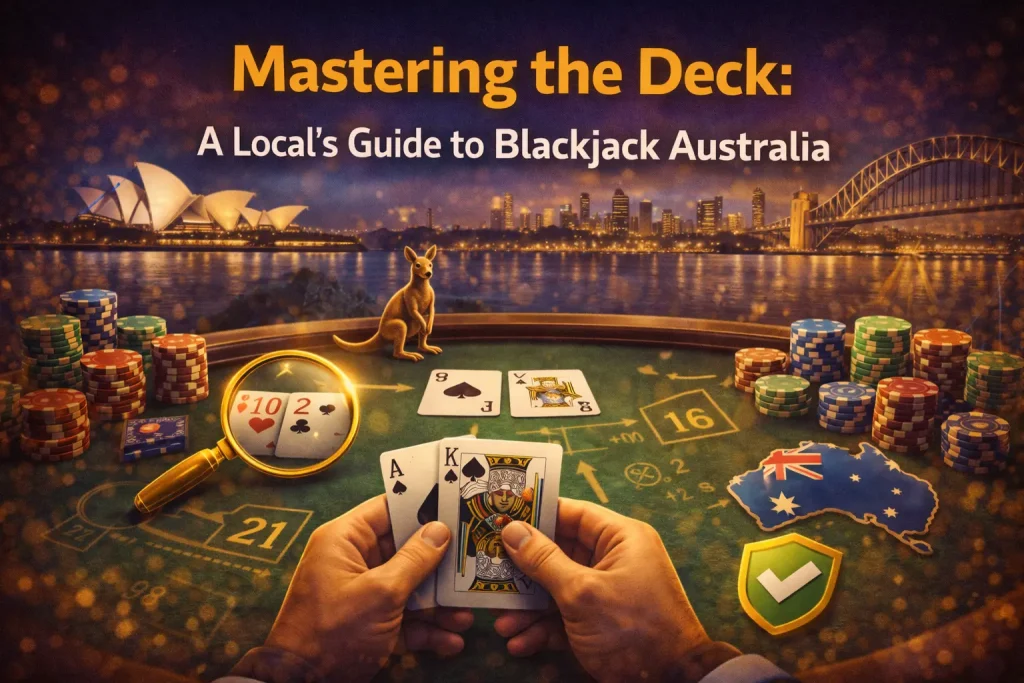
Mastering the Deck: A Local’s Guide to King Johnnie Online Blackjack Australia
UK Bingo and Blackjack Are More Similar Then You May Think
 Both Games Are Based Around Luck
When playing a game of UK bingo, the aim of the game is to be the first person to make a certain pattern with the called numbers in order to win the game. When playing a game of online blackjack, the aim of the game is to get as close to 21 as possible without going over. Both of these are based around luck.
In a game of blackjack you are not allowed to see what the next card is, you have to take a chance and say ?hit? to accept it. Without you seeing what the next cards are you are solely going based on luck, even when you first start the game and you receive your first 2 cards; this is based on luck as you have no say on which cards you will receive.
In a game of bingo you buy tickets into a game and then a caller calls out numbers at random, you then mark these called numbers on your bingo cards. You have no say on which number will be called next nor does the bingo caller. Again this is then a game based on luck.
Easy to Master
Unlike Poker, both bingo and blackjack are easy to master and you are usually on to your way at becoming a novice just after a few games. Both versions of gambling have few rules each so anyone who wishes to try gambling for the first time is advice either to try blackjack or bingo.Social
Bingo is a huge social sport and the game used to be based entirely on socialising when it was huge in UK bingo clubs. Playing on online bingo sites you still get the chat rooms where you can talk which still makes the game social. Blackjack, even though not many people associated the game will socialising as some players tend to like peace and quiet while they think it is still a social sport. Especially for professionals, the rules are not hard to master, so once you know how to play the game you are free to talk to other players, even online you get chat rooms just the same as online bingo.They Are Not Classed as Gambling
Believe it or not but both UK bingo and UK blackjack are not gambling on their own. It is only when you add something to wager that the games become gambling. But come on, would you log on your computer and start playing for fun? More than likely, you are in it for the money.Maximise Potential Returns
Triple 7’s Blackjack
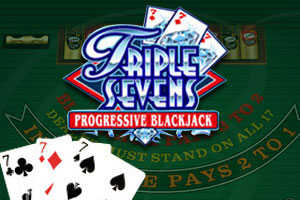 Blackjack fans will like this version of the game from Microgaming with the opportunity to grab the Progressive jackpot. The standard blackjack rules apply but you have to make a mandatory $1.00 triple 7?s side bet.
You of course play to beat the dealer on 21 but the real objective of this version is to get consecutive 7?s. There are 5 decks of cards which are re-shuffled after every game so the 7?s are there!
The rewards for 7?s are as follows
- Two consecutive 7?s of mixed suits wins seven credits
- Two consecutive 7?s of the same suit wins fifty credits
- Three consecutive 7?s of mixed suits wins two hundred and fifty credits
- Three consecutive 7?s of the same suit wins one thousand credits
- Three consecutive 7?s of diamonds and you win the Progressive jackpot
It is worth noting that even if you lose against the dealer on 21 you still win your credits on 7?s
Play Triple 7’s Blackjack now at:


Blackjack: Splitting Tens
 One of the most exciting ? and daunting ? experiences at the Blackjack table is when the dealer hands you a pocket pair. Let us talk about the daunting feeling first.
Unless you are a hardened gambler, the thought of doubling your outlay on a single bet can sometimes be a worrying one.
Luckily, for most players, the added incentive of the potential for a double windfall eases that worry slightly.
Either way, it is an exciting time, so let us have a look at the act of splitting pocket pairs, as we concentrate on pocket tens.
Splitting pocket tens is not a very profitable play, and this is because your score of 20 is mathematically more likely to beat the dealer. The dealer would have to draw Blackjack to beat you, or draw a 20 for the split.
So, for the recreational player, it is always better to stand on pocket tens. The card counter does have a slight advantage if they know that the deck is loaded with high cards, but this is still the far riskier play than just simply standing.
20 is one of the strongest hands you can ever hold in Blackjack, so, when you receive pocket tens, you have already reached your goal of drawing either 21 or a hand as close to 21 as possible.
If you are playing at a table where you notice someone splitting pocket tens, then it is safe to assume that they are a recreational player.
You are not playing against the player but their actions still have a direct impact on the cards you receive.
For some players, this does not matter but for others it can drive them insane, as the recreational player splits pocket tens and picks up a card that would have made you 21, should they have stood on their original 20.
Become an online blackjack winner on intercasino.com.
Simple But Helpful Online Blackjack Tips
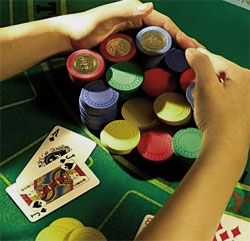 Blackjack is one of the simplest and most popular types of online casino games out there. Even though there are a few different variations of the game, the basics are more or less the same.
There are a lot of different strategies used by players, but everybody has their own style of playing. Whether you?re a newcomer to online blackjack or a seasoned pro, there are some tips that might help you out.
- Learn the rules of all the online blackjack games you?re going to play. You should then practice and play for free before you?re comfortable with the idea of playing for real money.
- You should come up with a playing limit or budget and make sure you stick with it. You?re going to have good days and bad days so know when to call it a day.
- Check out all of the online tournaments, promotions, and bonuses that are offered at various online casinos. This will help you get the most out of your money.
- It?s important that you don?t give out any of your personal account information to anybody that you don?t know and trust.
- Try to learn all of the terms related to the online blackjack games so you understand what?s happening during the action.
- Withdraw at least half of your winnings after you win a big amount. This will help stop you from playing it right away and you?ll leave the game with some winnings.
- Try to get your cards as close to 21 as possible instead of trying to beat the dealer. If the dealer has a high card showing don?t let it distract you.
- Don?t forget about betting cycles in online blackjack. You should bet more when you?re winning and less when you?re losing.
- Remember, online blackjack favours the dealer. If you both go over 21, you lose.
- If the dealer has to take a card on hands that are 16 and lower, you won?t win with less than 17 unless the dealer goes over 21.
- Remember that an ace can be used as either one point or 11 points.
- If your cards total 10 or lower you should take another card as you won?t be in jeopardy of busting. The most you can get is an ace to total 21, which of course is what you?re aiming to do.
Written by Alex, a blackjack aficionado who enjoys blogging about her casino experiences. She loves detailing her wins and losses for the amusement and entertainment of others!
Splitting in the game of Blackback
There are four options available to the player in a game of Blackjack once he has been dealt his starting cards. One these is to split but what exactly does this mean?
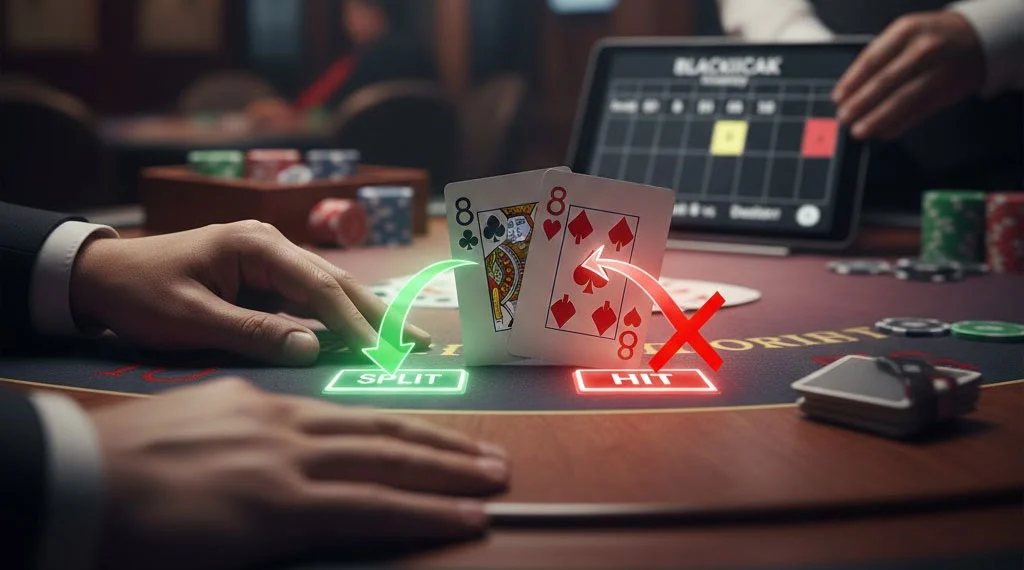
Sometimes when you are playing Blackjack you will be dealt a pocket pair such as 88, 66, 44, etc. When you are dealt a pocket pair you have the option to split. Splitting means that you divide the two cards into two separate hands. The dealer then deals you two separate cards, one to each hand, giving you the net result of two hands instead of one. When you decide to split you also have to double your wager because you are now betting on the outcome of two hands. Anyone who is unsure as to what they’re doing may be better off sticking to video poker instead.
The number of times that you are allowed to split your hand will depend on the rules of the particular casino you are playing in. Imagine you have two eights and decide to split and the dealer deals you another two eights; in some casinos you will be able to split the two eights again giving you the net result of four hands. As you can imagine the splitting of hands can win or lose you a lot more money than you initially bargained for, but it is one of the most exciting parts of the game. Remember, Blackjack has just as many nuances as slot games.
Another rule variation you need to look out for when splitting is when you are dealt a pair of aces. Some casinos will not allow you split aces, others will only allow you to draw one additional card on each ace and some will not recognize an eventual 21 as a 3:2 Blackjack hand. It’s important to bear these things in mind before you start.
Five Worst BlackJack Rules
Quick, can you tell me what are the five worst playing rules for blackjack? If you don’t know them then the next time you play blackjack you might just be bucking higher than normal odds. So let’s review these bummers to be sure you never play in a game that has them.
Blackjacks pay Even Money
This one stinks. Normally the casino pays 3 to 2 when a player gets a blackjack hand (and the dealer doesn’t also have blackjack). Getting paid 1 to 1 may not seem like a big deal but it is because the casino’s edge goes up by 2.3% (ouch).
Normally blackjack games that offer an even money payoff also have several other player favorable rules as a come on. A good example is SuperFun 21, which is offered in many casinos in Las Vegas. The game uses only a single deck of cards with liberal rules such as surrendering anytime including after hitting, doubling, or splitting. But the liberal rules do not come close to negating the 2.3% edge the house enjoys when it pays even money on blackjack hands. The bottom line is be very cautious when a casino only offers even money on a blackjack.
Blackjack pays 6 to 5
Oh come on, no casino would pay 6 to 5 for a blackjack hand you say? Well guess what? Walk up and down the strip in Las Vegas and you’ll find this game all over the place. The come on is that it’s advertised as a single deck game, which usually implies a good game for the player. But getting paid 6 to 5 on a blackjack is a much worse deal than getting paid the normal 3 to 2. How much less? For every $10 you bet and get a blackjack you’ll get paid $3 less. This increases the house edge by 1.2%.
What’s ironic is that these same casinos that offer this 6 to 5 abomination game also offer plenty of multiple deck games with a much lower house edge (partly because blackjacks are paid at the standard 3 to 2). Yet the last time I visited Las Vegas I observed all the 6 to 5 single deck tables packed with players while the multiple deck tables where much less crowded. I finally asked one player who had quit playing the 6 to 5 single deck payoff game why he choose to play it rather than the better multiple deck game. His response was that he thought 6 to 5 was a better payoff than 3 to 2. So much for the math skills of the average blackjack player (which is probably why the casinos in Las Vegas are blazingly getting away with offering this game to clueless tourists).
Doubling Down only on 11 or 10 or just 11
Often you’ll see this rule in single deck games where a player is restricted to doubling on a two card 10 and 11 (or just 11). This means you can’t double down on 9 or any soft hand (that’s not good). The house edge goes up by about 0.7% when you can only double on 11 and by 0.25% when you are restricted to just doubling on only 10 and 11.
Using 8 decks of Cards
Compared to a single deck game, the casino’s edge increases by 0.61% when 8 decks of cards are used. You would need several liberal rules to offset the 0.61% edge to make the game playable. At the minimum make sure the dealer stands on soft 17 and doubling after pair splitting is offered (ideally also late surrender).
Dealer Hits Soft 17
Many casinos (especially on the Las Vegas strip) have changed the dealer rule regarding soft 17. It used to be pretty standard that dealers must stand on all 17 hands (which includes a soft 17 hand). Nowadays, however, more casinos are changing to hit soft 17. That’s not a good change for the player because the casino edge increases by 0.20%. Given a choice you are better off playing where the rules require that dealers must stand on soft 17.
Probably the worse blackjack rule that I ever saw was dealer winning all ties. Yes, I know that’s the way you play it with your buddies when you get together for a friendly game of blackjack and poker. But in a casino, you should never play any blackjack game where the dealer wins ties. The standard casino rule is when your hand totals 21 or less and the dealer ends up with the same total, it’s a tie or push and you don’t lose or win your bet (but remember that a dealer blackjack hand beats a player’s three or more cards 21 hand). By winning tied hands the casino edge zooms by about 9%.
There are two things to keep in mind when you play blackjack. First, there has never been a game with exotic rules that has a lower house edge than the standard game. So before you decide to try a SuperFun 21 or other ‘new’; game you better check the rules.
Secondly, you should always try to pick your games carefully so that the overall mix of rules leads to a casino edge that’s as low as possible for the game you are playing (this of course assumes you know the basic playing strategy – if not, learn it!).
Dan Pronovost showed the effect of each rule on the house edge in his excellent article, Picking the Right Game, that appeared in issue #35 of the Blackjack Insider Newsletter (www.casino.com/newsletter/blackjack/archive/). This article is a good starting point to be sure you understand the impact a rule has on the house edge.
Often casinos will introduce new rules or games in their blackjack pits. An example is the new game Blackjack Switch, which recently had a trial run in Atlantic City and will soon be launched in casinos there and in Las Vegas (it’s also offered on the Internet). In this game you must play two hands and you are allowed to switch the two top cards. That very favorable player rule is offset by this new rule – when the dealer has 22, all player hands of 21 or less push (instead of win). So is the favorable switch rule offset by the very unfavorable push 22 rule? The answer is I don’t know at the moment but I’ve got several blackjack mathematicians working on this as we speak to determine the overall impact on the player (we hope to have it all unraveled in the next issue of the Blackjack Insider Newsletter).
That’s it for now. Stay positive and make sure you know the rules before you play.
By Henry Tamburin