Search Results for: EPT

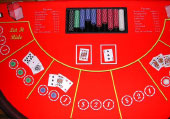
Let it Ride

Let it Ride BlackjackThe game of Blackjack has been available in online casinos since their conception. It is one of the few games where a decent knowledge of conventional blackjack strategy can reduce the house edge to a 50/50 split and one of the reasons why it is so popular. Whenever you have a game worth a flutter, perhaps at a Live Casino, someone will design a betting system for you to use, and Blackjack is no different.

One such betting system used at the Blackjack tables is called Let it Ride. Let it Ride is a positive progression betting system similar to the famous Martingale system. It’s one of the oldest forms of betting systems in operation and takes its form from the same concepts that banks use to compound interest. Let it Ride is often used in horse racing betting as well as Blackjack.

Here is the Let it Ride system in action?

You are a high roller and are playing at a $50-1000 limit table and you start by playing $1000 per hand. You are having a lucky night and start off by being dealt Blackjack immediately while playing for $1000 per hand. At odds of 3:2 you receive $1500 profit along with your original stake. You now have $2500 as a result of that bet and so you now: Let it Ride!

You could try to test your success at the system on the Live Dealer Blackjack, but you need to remember that this betting system is not for the faint-hearted and it will keep you on the edge of your seat all night long. In order to keep a modicum of control it is often prudent to select a stop-loss or profit target in advance of your session as this will make sure that you don?t get too carried away with all the excitement of Let it Ride!

Live Casinos to Play Blackjack

Where to Play Live Blackjack

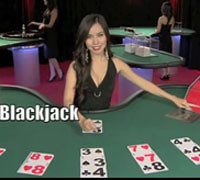
live casinos to play blackjackPlaying blackjack is always thrilling and exciting, but only live blackjack gives us the opportunity to feel that true atmosphere of risk and adventure, the atmosphere of real cards and the casino tables. Where to play live blackjack? Nowadays many of the online casinos provide players with a live dealer to play with. You are free to select download or no download version of blackjack. It is not required to install any special software to enjoy your favourite game. Just connect to the Internet and have a wonderful time with live dealer and other players.

If you are not ready to risk it, you can easily just play for fun, offered in most of the casinos. Otherwise, you are welcome to play blackjack for money and to increase your profit while a having good time.

You may also be interested in the variations of live blackjack. Firstly, you can choose between Game View or Casino View. The Game View will increase your impression of reality and will allow you to feel the interaction between players. Casino View will suit the players that have a slower internet connection.

Live Dealer Blackjack Games

live blackjack gamesLive blackjack games include Single Seat Blackjack and Early Payout Blackjack. According to the rules of the first type, you have your own cards and should not share them with other players.

Blackjack with Early Payout game enables you to perform the cash out with the help of the Basic Strategy. This means that you are allowed to stop the game and take your winnings, or continue playing. Moreover, the money prizes in these games are usually higher.

Live Casino Blackjack Bonus

The most beneficial bonus offered is no deposit welcome bonus. New players are presented with an opportunity to try several live casino games and to choose the most appropriate one without depositing money. The advantage of some casinos is that they give you the opportunity to play with free cash. Remember that special bonuses in many live casinos depend on the means of payment that you used to deposit. Unfortunately, not all live casinos accept USA players so you should pay attention to that before you decide to try the game.

Playing live blackjack is as easy as playing online and as exciting as real casino. It is available for everyone!

Play Blackjack Professionally

If you don’t have much Blackjack experience, it can be daunting stepping up to the tables for a game. You can, however, hide the fact of your inexperience very simply by remembering these straightforward rules. (Note – the rules of BlackJack will differ from area to area and from casino to casino, but the general principles are the same. When in doubt, ask!). A typical BlackJack table seats a dealer and up to 7 players. Starting with the dealer, the first seat on his left is ‘1st Base’, while the first seat on his right is referred to as 3rd Base. In front of each player’s seat is a betting square, printed on the felt. Right in front of the dealer is the chip tray, while on his left is the deck (a.k.a. shoe) and next to that is the’ minimum bet sign’, which tells you how ‘expensive’ the table is. As a beginner, you will want to stick to the low bet tables to keep any losses under control. On the dealer’s right is a money drop slot. This is a security feature – casinos don’t really trust their employees, and all cash and chips are deposited here to prevent ‘leakage’.

Next to the drop slot is what’s known as the ‘discard tray’. Play starts after the dealer shuffles the cards, the deck is ‘cut’ by a player using a ‘marker card’ (NOT the bare hand), and finally the dealer ‘burns’ a card (or throws it away in order to ensure randomness). Before the cards are dealt, you make your bet by placing chips or cash into the betting box. Be aware that you can sit out a hand or 2 if you like – maybe you need a break, or the dealer is just on a lucky streak. Note that if the casino is busy, you may be asked to give up your seat so another punter can take your place (or alternatively resume the game yourself). If you really don’t want to play, just get up and vacate the seat – you can always come back later!

When all players who want to play in this round have placed a bet, 2cards will be dealt to each player going from left to right. Some casinos deal the cards face down. Elsewhere the cards are dealt face up, in which case NEVER touch them – the assumption if you do is that you are cheating! The dealer deals himself 2 cards – 1 down and 1 up. Card values are, as everyone knows, 10 Jack Queen and King are worth 10, an Ace is worth 1 or 11, all other cards are worth their face values. In noisy casinos, be prepared to use hand signals to indicate whether you want to hit or stand.

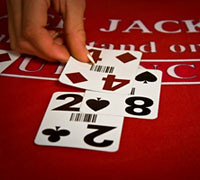
How do you indicate ‘hit’? If the cards are dealt face down, flick the cards gently across the felt 2 times. If the cards were dealt face up, point at the cards with your finger in a jabbing style. You can nod your head to emphasize the desire for a hit. If you’d prefer to stand, move your hand horizontally from left to right (palm down) to indicate ‘no’. Always keep your hands a few inches off the table to avoid suspicion. If you like, you can emphasize the stand by shaking your head ‘no’ at the same time.

Should you play single or multiple deck games? Only in Vegas do they still play single deck, and the tables are usually full – it is much easier for amateurs to ‘count’ in a single game, and keep the odds pretty fair, which explains their popularity. Multiple deck games will usually be based on even number of decks (up to 8 decks in the shoe at a time). Multiple decks allow the dealer to deal more hands per hour (less shuffling etc), which makes them more profitable for the casino, and they reduce the chances of a player ‘counting’. Dealers HAVE to follow straightforward rules, and must hit if they have 16 or less. On the other hand, if the dealer has 17 or more, he MUST stand, except in some smaller casinos, where he can hit on a ‘soft 17’.

You as the player can do anything you like, standing or hitting as it suits you. If you get a BlackJack (an Ace and a ten right off) you win 1 and a half times your bet. You can only double down on 2 card hands totaling 9, 10, or 11 (a very few casinos allow doubling on any 2 card hand). If your cards were dealt face down and you want to double, turn them over and put them on the dealer’s side of the betting square. Otherwise point to them and say ‘double’ when it’s your turn. You will have to put an equal amount of chips next to those already in the betting box (NEVER put new chips on top of old chips – it looks like cheating!). You will get one new card.

Splitting is kind of similar – cards dealt face down need to be turned over and placed them a little apart. Otherwise point at them and say ‘split’ when it’s your turn. Place an equal amount of chips in the betting box near the other card (remember, NEVER on top). You are now playing 2 hands exactly as normal (unless you just split two aces in which case you only get one card – a 10 would be good!. If it is a 10 the hand isn’t a BlackJack, meaning you only get the standard odds of 1/1 and not 1/1.5 as you would for a ‘natural’ BlackJack. Be careful how you split – it is possible to end up with 4 or 5 hands simultaneously! Likewise, it’s probably not good to split two 5s – you will be replacing a hand that is great for drawing on or doubling down on with (probably) 2 poor hands. Insurance only happens when the dealer’s face up card is an Ace, when the dealer will ask the players if they want insurance (he won’t know what his face down card or ‘hole’ card is at this point, so you won’t be able to read his expression for clues). Insurance means that half the player’s bet is placed on the ‘insurance’ semicircle printed on the felt. If the dealer gets a BlackJack the player wins the the insurance bet but loses the original bet meaning a zero hand because insurance pays 2 to 1. If the dealer does not get BlackJack, the insurance bet is lost and the hand is played normally with the remaining half bet. Don’t bother with insurance unless you are trying to card count (take it when the number of non ’10’ cards to 10s drops below the 2 to 1 margin). You may also come across ‘Surrender’ – it’s not widely used, but there are 2 versions you may find, ‘early surrender’ and ‘late surrender’.

Early surrender means quitting on 2 card hands if you don’t like the dealer’s up card (e.g. a ten or court card). Surrendering in this way will give you a small extra advantage whcih is why casinos don’t like it. Late surrender means waiting until the dealer checks for BlackJack, at which point if he doesn’t, you may decide to surrender. As we say, not very common, so ask before joining the table whether you can or not. And that’s it! Stay cool, and don’t panic, and nobody will guess you are a casino newbie!

Blackjack Player Options

Standing
The player elects to “stand” with the current total and not to draw any additional cards. If you are in a game where the cards are dealt face-down, you slip your cards under your chips. The dealer will understand the message. If you are in a face-up game, wave your hand back and forth in a wiping motion just above your cards, which is the signal for standing. All casinos insist on some form of hand signal; verbal statements are not accepted. Casinos can get rather noisy, and it is easy for a dealer to mishear a player. Also, the cameras hidden in the casino’s ceilings can be used to resolve disputes only if hand signals are used, since they do not have an audio component.
Hitting
The player elects to draw an additional card or cards. If you are in a face-down game, draw your cards toward you with a quick scratching motion against the felt once or twice. In a face-up game, make a similar motion with your fingertips or , preferably, point to your cards with your index finger.
Splitting
If your first two cards are of the same value, you may split them and play each as a separate hand. To indicate a desire to split your cards, place an additional wager equivalent to the original one to the side of it. If you are playing in a face-down game, you must expose your cards. After splitting a pair, various other options become available. You can re-split if a third like-valued card appears. Or you can double down on the split hands should an appropriate card be drawn. For example, if you have split 8’s and catch a 3 on the first 8, you may now double down on this total of 11. Both re-splitting and doubling and doubling down after a split are to the player’s advantage.
Doubling Down
The player may double the size of the original bet and elect to draw only one additional card. The typical doubling situation is where you have a hand that stands a chance of becoming a _very_ good hand with one additional card; for example, your first two cards total 10 or 11. To indicate a double down bet, slide a second wager to the side of the original bet. This wager may be as much as but no more than your original bet. If you are playing in a face-down game, you must expose your cards. Virtually all casinos permit doubling on 11 and 10; most on 11, 10, and 9, and many will allow it on any two cards. The latter rule is the most advantageous to the player.

How to Play Blackjack

The game itself is simple. You, the player, attempt to accumulate cards with a numerical total closer to (but not more than) twenty-one than those accumulated by the dealer. If you do so, you win. If the dealers’ total is closer to twenty-one than yours, you lose. Winning hands are paid off at even odds. If you and the dealer both arrive at the same total, the hand is a “push,” and nobody wins. All bets must be made before any cards are dealt, and no bet may be changed once the first card has been dealt.
Each player is initially dealt two cards; they may be face-down or face-up, depending on the rules of the casino. The dealer gets two cards, one face-up and one face-down. The value of the cards is given by their face value except that the ace (A) counts as either 1 or 11 and the 10, jack (J), queen (Q), and king (K) all count as 10.
The combination of an A and any 10 on the first two cards is a blackjack and is an automatic winner (unless both dealer and player have it, in which case it’s a push). A player blackjack is paid at 3 to 2. When the house has a blackjack the player merely loses his bet and not one and a half times that bet. Any combination of cards that exceeds 21 is a bust and a loser. The player always goes first, so if the player’s total exceeds 21 the hand is lost — even if the dealer also busts later. If the dealer busts, all remaining players are winners. The dealer has no options; play is fixed by the rules.
After the first two cards are dealt, the player must decide whether or not to take additional cards based on two pieces of information: the cards held and the dealer’s upcard. This is where the game begins to get interesting. A wide variety of options offer themselves, and unless the player understands the principles of the game there are numerous ways to go wrong. Let’s review the options first; correct play will be discussed later.

Counting Cards

Many inexperienced players have a misconception about card counters as mathematical geniuses who can keep track of every card in a multiple decks of cards. While there may very well be people who can do this kind of thing, card counting is not about keeping track of every card. The idea behind counting cards is to keep track of the players statistical likelihood of winning a hand and then adjusting betting and playing accordingly.
The idea behind card counting is simple gambling strategy. Any professional gambler will tell you that the way to win at gambling is to bet more when you have the advantage and bet less (or not at all) when you do not. It is that simple. In black-jack, certain cards remaining in the deck are good for the player and certain ones are not. If you “count” these cards, you will always know when you have the advantage.
Edward O. Thorp’s work confirmed that 10’s and A’s remaining in the deck were good for the player, while 5’s and 6’s remaining in the deck were bad for the player. He worked out the circumstances under which particular combinations of cards remaining in the deck gave the player and advantage over the house. He also presented the first two card-counting systems, Thorp’s five-count and Thorp’s ten-count. The latter, which is more powerful, was based on determining the ration between 10’s and non-10’s remaining in the deck. Card counting was born from irrefutable logic: Keep track of the cards: make small bets when the deck favors the house and large bets when it favors the players.
Thorp’s analysis was later improved upon by the work of many others, notably Julian Braun, Lawrence Revere, Peter Griffin, Stanford Wong, Ken Uston, Arnold Snyder, and Lance Humble. Today the game is understood at a rather deep level, and sophisticated systems exist that give the knowledgeable player a distinct edge over the house.
Which Cards Matter?
The object of card counting is to keep track of cards that are advantageous to the player. The simple question is, then, “which cards matter?”
The card most beneficial to the player is the 10. 10’s are ad-vantages to the player for several reasons. One, they will cause the dealer to bust since he is required to take cards based on the rules of play. He may not take other factors into account while playing (like you do!). Two, they turn hands that you double down on into very strong hands (which is why you double down on those hands, by the way). Three, they are used to create blackjacks. Remember that blackjacks are more beneficial to the player since getting one pays 3 to 2 but losing to one only costs the original bet! Another important card for the player is the A. Aces present soft doubling (and hitting) opportunities and they create blackjacks. Remember – blackjack is more important to the player than the house!
The worst cards for the player are the 5 and the 6 (and 2, 3, and 4 to a lesser degree). The reason these are not good for the player is simple – they are beneficial to the house. Since the house is forced by the rules of play to take cards on any hand lower than 17, the 5 and the six present the possibility of very strong hands for the dealer (remember that 10’s are not advantageous to the dealer since they make “busts” of these hands).
Before we begin to learn how to count we should talk about how this will help us. You should remember that the purpose of counting is to know when the player has an advantage and when he does not. This knowledge will do nothing for you unless you do something with it. What you want to do is adjust your betting and your play based on your advantage.
Adjusting Your Bets
Adjusting your bets is very straightforward. When the composition of the deck is in your favor, you bet more. When it is not, you bet less. Very simple. Learning just this can give you as much as a 2% advantage against the house. If that advantage does not sound like much, keep in mind that many casino slot machines only produce a 2 – 3% advantage for the casino and that is enough to make billions of dollars of profit for the casino. Granted, this is at a much higher volume than you will play at but remember that bet sizes are much smaller.
Adjusting Your Play
Learning to adjust your play based on deck composition is not an easy task, but the rewards are phenomenal. Taking this step can increase your advantage by another 2% for a total of 4% against the house. The good news is that you can learn this with a lot of practice. The principles are simple but mastering this level of play takes many hours of practice.
An expert card counter will adjust play in many different ways depending on the composition of the deck. It is common for an expert card counter to do things that “break the rules” of basic strategy like:
1. Standing earlier if the deck is very 10 rich — if the dealer can bust, so can you!
2. Standing later if the deck is very 10 poor.
3. Splitting 10’s when the deck is extremely 10 rich.
4. Doubling down on A, 9 when the deck is extremely 10 rich.
Of course, the most important play adjustment can be deciding when to start playing at a table and when to stop.

When To Split

The guidelines for splitting are best described in a table.
Split If Dealer Shows
A , A Any Card
10 , 10 Never
9 , 9 2 – 9 except 7
8 , 8 Any Card
7 , 7 2 – 7
6 , 6 2 – 6
5 , 5 Never
4 , 4 5 or 6
3 , 3 2 – 7
2 , 2 2 – 7

Again, when there is some logic behind these guidelines.
? Always split A’s. The totals of 2 or 12 are not nearly as good as hitting 11’s.
? Never split 10’s. Two 10’s is a great hand — don’t screw it up!
? Never split 5’s, but you may want to double down!
? Splitting 4’s is a close call. Don’t do it in one or two deck games. Do it in multi-deck games when the dealer shows a 5 or 6.
? Split 9’s against a dealer card of 2 – 9 except 7. The reason for this exception is simple. You have 18. The dealer’s most probable total is 17. Don’t screw up a good thing.
? Splitting 8’s, like 4’s, depends on casino rules. Always do it when the dealer shows 2 – 9. If the dealer shows 10 or A and you happen to be lucky enough to be playing in a game that allows early surrender, you should surrender. If surrender is not an option, split.
? Splitting 6’s and 7’s is straightforward. If the dealer’s card is higher than your card, don’t split.
? Always split 2’s or 3’s if the dealer’s card is less than 8.
You should also note that the “value” of splitting is increased if you are playing in a game that allows doubling down after a split.

Basic Strategy Play

Since the essential features of basic strategy were developed, a number of refinements have given us the current optimal set of principles for standing, hitting, doubling, splitting, and surrendering. These, along with the other more sophisticated forms of play were worked out by using Monte Carlo techniques based on the analysis of literally billions of hands. If I tell you that you should hit a total of 16 against a dealer’s 7, there is no specific mathematical proof behind this recommendation. It emerged from an analysis of the several million times this situation emerged in the Monte Carlo analysis of the game. Hitting a 16 against a 7 loses less often than standing. Sure, following this advice produces a bust on a lot of these hands, but analysis shows, utterly compellingly, that if you don’t hit his hand you are more likely to get beat by a higher total — like 17.
When possible, I will give a logical analysis of particular aspects of basic strategy, but there are going to be situations where the reader is just going to have to accept the outcomes of the Monte Carlo analysis. The following description of basic strategy is based on the multi-deck game found in several Atlantic City and Las Vegas casinos, where the dealer stands on a soft seventeen, pairs may be re-split once, doubling down is permitted after a split, and the player may double down on any two cards. Other games require some minor adjustments that I’ll note where appropriate. However, you should never give up an edge against the casino. I highly recommend playing only where the rules are more favorable to the player.